


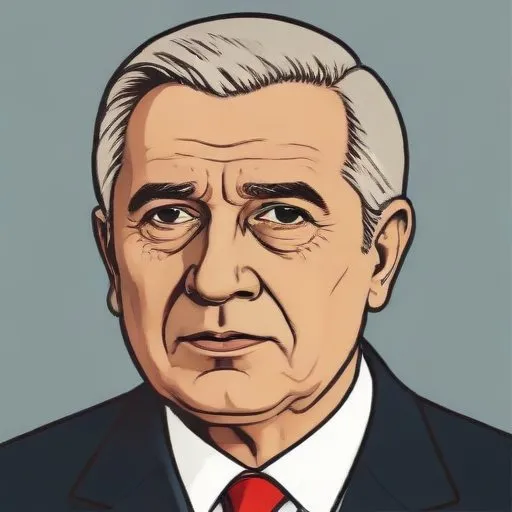
Led the Communist Party of Czechoslovakia, implementing reforms and normalizing relations with the Soviet Union after the Prague Spring. Known for his role in shaping the country's post-war history.
Gustáv Husák, a Czechoslovak politician, is infamous for his authoritarian rule as the First Secretary of the Communist Party of Czechoslovakia from 1969 to 1987 and President of Czechoslovakia from 1975 to 1989. His tenure is notorious for the period of normalization, a crackdown on political dissent and civil liberties, following the 1968 Prague Spring.
Husák was born on January 10, 1913, in Pozsonyhidegk, Kingdom of Hungary (now Bratislava, Slovakia), to an unemployed worker. He joined the Communist Youth Union at the age of 16 while studying at a grammar school in Bratislava. In 1933, he began studying law at Comenius University, where he joined the Communist Party of Czechoslovakia (KSC), which was banned from 1938 to 1945.
During World War II, Husák was periodically jailed by the Jozef Tiso government for his illegal Communist activities. He was one of the leaders of the 1944 Slovak National Uprising against Nazi Germany and Tiso. After the war, he began his career as a government official in Slovakia and party functionary in Czechoslovakia.
From 1946 to 1950, Husák was the head of the devolved administration of Slovakia, where he contributed to the liquidation of the anti-Communist Christian Democratic Party of Slovakia. His loyalty to the central organs of the Czechoslovak Communist Party and his talent for political manipulation earned him a reputation as a ruthless politician.
In 1969, Husák became the First Secretary of the Communist Party of Czechoslovakia, a position he held until 1987. He implemented the period of normalization, a series of repressive measures aimed at crushing political dissent and restoring authoritarian control. The period was marked by strict censorship, the suppression of civil liberties, and the persecution of dissidents.
Husák's rule is widely regarded as one of the darkest periods in Czechoslovakia's history. His policies led to widespread human rights abuses, and his regime was marked by corruption and nepotism. Despite this, Husák remained a prominent figure in Czechoslovak politics until his death on November 18, 1991.
"We will not let anyone undermine the authority of the party and the state." - Gustáv Husák, 1970
"The Prague Spring was a counter-revolutionary movement aimed at destroying the socialist system." - Gustáv Husák, 1971
Husák's rule must be seen in the context of the Cold War and the struggle for power within the Eastern Bloc. His rise to power was facilitated by the Soviet Union's support, and his policies were shaped by the need to maintain Soviet hegemony.
Today, Husák's legacy serves as a reminder of the dangers of authoritarianism and the importance of protecting human rights and civil liberties. His rule serves as a cautionary tale about the corrupting influence of power and the dangers of unchecked authority.
Born in 1921
A Slovak politician who led a brief, failed attempt to reform communism in Czechoslovakia during the Prague Spring of 1968, known for his efforts to introduce democratic reforms.
Born in 1893
Led the German Democratic Republic (East Germany) from 1950 to 1971, implementing socialist policies and building the Berlin Wall. He's known for his strict communist rule and dividing a nation.
Born in 1886
A German communist leader who fought against the Nazi regime and was eventually executed, becoming a martyr and symbol of resistance against fascism.
Born in 1896
Leader of the Communist Party of Czechoslovakia who oversaw the country's transition to a socialist state and served as president from 1948 to 1953. He's known for his role in establishing a Soviet-backed government in Czechoslovakia.
Born in 1904
The President of Czechoslovak Socialist Republic and General Secretary of the Communist Party of Czechoslovakia, who ruled with an iron fist from 1957 to 1968, suppressing dissents and reform efforts. He's most known for his authoritarian regime and eventual ousting during the Prague Spring.
Born in 1895
A Czech general and politician who served as the 8th President of Czechoslovakia, leading the country through a tumultuous period of Soviet occupation and reform. He's most known for his role in the Prague Spring and subsequent Soviet invasion.
89 Years Old
A Czech poet, playwright, and politician who led the country's transition from communism to democracy, and is known for his advocacy of human rights and individual freedom.
Born in 1922
A Czech communist politician who served as the General Secretary of the Communist Party of Czechoslovakia from 1953 to 1968, known for his role in suppressing democratic reforms.
