


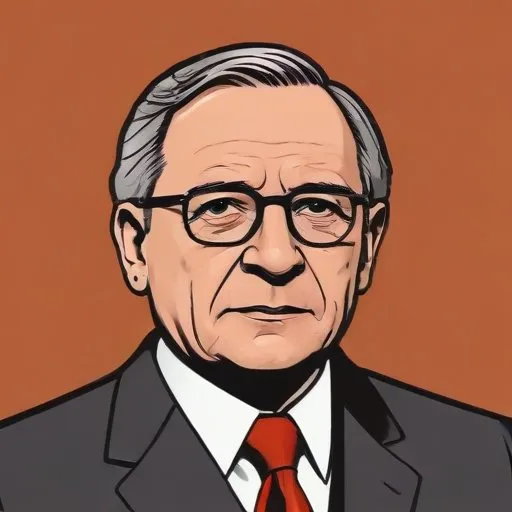
A German communist leader who fought against the Nazi regime and was eventually executed, becoming a martyr and symbol of resistance against fascism.
Ernst Thlmann was a prominent German communist politician who led the Communist Party of Germany (KPD) from 1925 to 1933, playing a pivotal role in shaping the country's political landscape during the tumultuous Weimar Republic era. As a committed communist, Thlmann's leadership was marked by his unwavering loyalty to the Soviet Union and Joseph Stalin's policies, often putting him at odds with other political factions in Germany.
Born on April 16, 1886, in Hamburg, Germany, Thlmann's early life was marked by hardship and instability. His parents, Johannes and Mary-Magdalene, were a farmworker and a deeply religious homemaker, respectively. After his parents were convicted of theft and sentenced to prison in 1892, Thlmann and his sister Frieda were placed in separate foster families.
Thlmann's political awakening began during his teenage years, when he worked as a dockworker in Hamburg. He joined the Social Democratic Party of Germany (SPD) in 1903, but soon became disillusioned with the party's moderate stance. In 1918, Thlmann co-founded the Communist Party of Germany (KPD), which he would later lead from 1925 to 1933.
Under Thlmann's leadership, the KPD became increasingly radicalized, often clashing with the SPD and other political parties. His party's stance on the SPD as "social fascists" sparked intense controversy, and his unwavering loyalty to Stalin's Soviet Union raised concerns about the KPD's autonomy.
Thlmann was also leader of the paramilitary Roter Frontkämpferbund (Red Front Fighters' League), which further polarized his reputation.
In 1933, Thlmann was arrested by the Gestapo and held in solitary confinement for 11 years. Initially, Stalin and Molotov sought his release, but after the Molotov-Ribbentrop Pact, efforts to free him ceased. Ignored by his party rival Walter Ulbricht, Thlmann was shot dead by Adolf Hitler's personal order in Buchenwald on August 18, 1944.
Ernst Thlmann's legacy is marked by controversy and complexity. While praised by some for his unwavering commitment to communism, others criticized his Stalinist tendencies and divisive politics.
Despite his tumultuous life and tragic fate, Thlmann remains an important figure in German political history, serving as a testament to the complexities and challenges of the Weimar Republic era.
Thlmann's life and legacy must be viewed within the context of Germany's tumultuous Weimar Republic era, marked by political instability, economic crisis, and rising extremism. His commitment to communism and Stalinist ideology set him apart from other political leaders of the time, such as the SPD's Friedrich Ebert and the Nazi Party's Adolf Hitler.
Thlmann's leadership style and ideology invite comparison with other prominent communist leaders of the era, including Stalin and Lenin in the Soviet Union, and Mao Zedong in China. While sharing some similarities with these figures, Thlmann's unique blend of German nationalism and communist ideology sets him apart as a distinct figure in the history of communism.
Born in 1897
A mastermind of Nazi propaganda, he crafted a persuasive narrative that fueled the Third Reich's rise to power, leaving a lasting impact on the world.
Born in 1889
The dictator of Nazi Germany, responsible for the genocide of six million Jews and millions of other people during World War II, and infamous for his extreme nationalist and anti-Semitic ideology.
Born in 1893
A high-ranking Nazi official, he was a decorated World War I fighter pilot and later became a prominent politician, serving as Minister President of Prussia. He's infamous for his role in the Nazi regime and war crimes trials.
Born in 1893
A German diplomat who served as the Nazi regime's Foreign Minister, orchestrating key alliances and treaties that led to World War II. He was a close associate of Adolf Hitler and played a crucial role in shaping Nazi foreign policy.
Born in 1894
A high-ranking Nazi official who flew to Scotland on a solo mission to negotiate peace with the UK, but was instead arrested and imprisoned.
Born in 1887
A high-ranking Nazi official who played a key role in the party's early development and was a close ally of Adolf Hitler, but was eventually purged and executed during the Night of the Long Knives. He's infamous for his leadership of the Sturmabteilung (SA) paramilitary group.
Born in 1893
Led the German Democratic Republic (East Germany) from 1950 to 1971, implementing socialist policies and building the Berlin Wall. He's known for his strict communist rule and dividing a nation.
Born in 1876
The first President of the German Democratic Republic, a key figure in East Germany's post-war government, known for his role in shaping the country's socialist policies. He played a crucial part in the country's early years, helping to establish its government and economy.
