


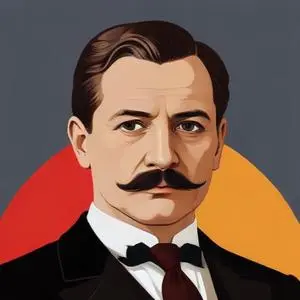
First President of Germany, leading the country through its early years of democracy and turmoil, known for his efforts to stabilize the government and economy.
Friedrich Ebert, a renowned German politician, is best known for being the first President of Germany from 1919 until his death in 1925, as well as the leader of the Social Democratic Party of Germany (SPD). His presidency marked a significant transition in German history, as the country shifted from a monarchical system to a republic.
Born on February 4, 1871, in Heidelberg, Grand Duchy of Baden, Ebert was the seventh of nine children to Karl Ebert, a tailor, and Katharina Ebert (née Hinkel). Due to his family's financial constraints, he was unable to pursue higher education and instead trained as a saddlemaker from 1885 to 1888.
Ebert's political career began in 1905 when he became the secretary of the SPD in Bremen. He quickly rose through the ranks, becoming the party's leader in 1913 after the death of August Bebel. Ebert's moderate social democratic views often put him at odds with more radical members of the party, particularly during World War I, when he supported war loans to finance the German war effort.
In 1918, Ebert played a key role in the German Revolution, which led to the abdication of Kaiser Wilhelm II and the establishment of a republic. As the first Chancellor of Germany, Ebert's primary objective was to restore order and suppress the left-wing uprisings that threatened the new government. To achieve this, he formed an alliance with conservative and nationalistic political forces, including the military leadership and the right-wing Freikorps.
Ebert's presidency was marked by controversy, particularly due to his role in suppressing left-wing uprisings and his alliance with right-wing forces. His decision to crush the communist and anarchist uprisings, including the Spartacist uprising, resulted in the deaths of many radicals, including Rosa Luxemburg and Karl Liebknecht. Despite these controversies, Ebert's legacy as a key figure in German history remains, and his presidency paved the way for the development of modern Germany.
Ebert's political beliefs were shaped by his moderate social democratic views, which emphasized the importance of social reform and cooperation between different social classes. He believed in the need for a strong state to maintain order and stability, while also advocating for workers' rights and social justice.
"The state is not an end in itself, but a means to an end. The end is the free and dignified development of the individual."
Friedrich Ebert's legacy is complex and multifaceted, marked by both significant achievements and controversies. Nevertheless, his role in shaping modern Germany and his commitment to social democracy continue to inspire and influence generations of politicians and citizens alike.
Born in 1865
The first Chancellor of Germany's Weimar Republic, known for proclaiming the country a republic from a balcony in Berlin, marking the end of the German Empire. He played a crucial role in shaping Germany's early democracy.
Born in 1876
The first President of the German Democratic Republic, a key figure in East Germany's post-war government, known for his role in shaping the country's socialist policies. He played a crucial part in the country's early years, helping to establish its government and economy.
Born in 1893
Led the German Democratic Republic (East Germany) from 1950 to 1971, implementing socialist policies and building the Berlin Wall. He's known for his strict communist rule and dividing a nation.
Born in 1912
The last communist leader of East Germany, known for his rigid adherence to Soviet ideology and his role in constructing the Berlin Wall.
Born in 1876
Led post-war West Germany's reconstruction and served as a key figure in shaping the country's modern identity, earning him the title "Father of the Federal Republic."
Born in 1884
First President of post-war Germany, credited with rebuilding the country and promoting democracy. He's also known for his strong advocacy for human rights and freedom of the press.
