


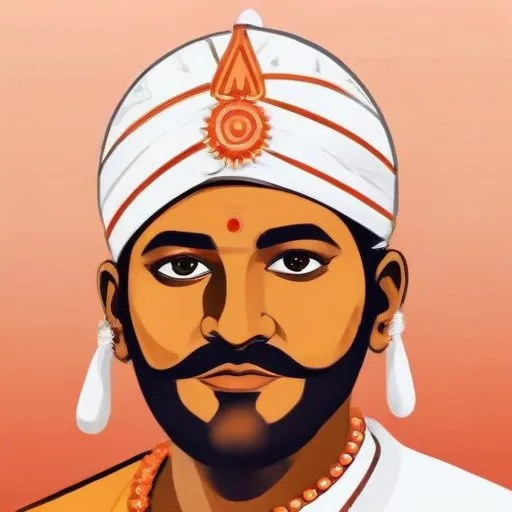
The third Chhatrapati of the Maratha Empire was a powerful Indian ruler who played a crucial role in the empire's expansion and defense against the Mughal Empire. He is known for his military prowess and strategic alliances.
Rajaram Raj Bhonsle, the third Chhatrapati of the Maratha Kingdom, is renowned for his valiant efforts to protect his empire from the Mughal forces during his 11-year reign from 1689 to 1700. He was the second son of the legendary Shivaji, the founder of the Maratha Empire, and his bravery and strategic prowess earned him a special place in the annals of Indian history.
Born on 24 February 1670, Rajaram was the son of Shivaji and his second wife, Soyarabai. He was thirteen years younger than his brother, Sambhaji, and was installed on the Maratha throne at the age of 10, following his father's death in 1680. However, the Maratha generals preferred Sambhaji as the king, and Rajaram's claim to the throne was initially rejected.
Rajaram married three times, first to Jankibai, the five-year-old daughter of Shivaji's army chief, Prataprao Gujar, when he was just ten years old. He later married Tarabai, the daughter of Sarsenapati Hambirrao Mohite, the Maratha army commander, and Rajasbai from the influential Ghatge family of Kagal. He had three sons, Raja Karna, Shivaji II, and Sambhaji II, from his wives.
After the execution of Sambhaji by the Mughals, Rajaram was informally crowned at Raigad on 12 March 1689. He vowed to avenge his brother's brutal murder and led the Maratha forces against the Mughals. Despite being outnumbered and outgunned, Rajaram's military tactics and bravery helped the Marathas hold off the Mughal forces, earning him the respect and admiration of his people.
Rajaram's coronation ceremony was performed at Raigad, with Maharani Yesubai, the widow of Sambhaji, playing a crucial role in boosting the morale of the Maratha garrison. Although he faced numerous challenges during his reign, Rajaram's unwavering commitment to his people and his kingdom earned him a lasting legacy in Indian history.
Rajaram's reign was marked by a constant struggle against the Mughal forces, but he also laid the foundation for the future growth and expansion of the Maratha Empire. His bravery and strategic prowess inspired generations of Maratha warriors and earned him a place among the greatest leaders in Indian history.
Rajaram's legacy extends beyond his military conquests, as he also played a crucial role in promoting the cultural and social development of the Maratha Kingdom. He patronized arts, architecture, and literature, and his court attracted scholars and poets from across the region.
Born in 1630
Founder of the Maratha Empire, a powerful Indian kingdom that resisted Mughal rule, known for military prowess, strategic genius, and unifying warring factions. He is revered as a national hero in India.
Born in 1657
The second ruler of the Maratha Empire, known for his bravery and military campaigns against the Mughal Empire, and his efforts to protect Hindu culture and traditions.
Born in 1700
The founder of the Maratha Empire, a powerful Indian kingdom, who expanded its territories through military campaigns and clever diplomacy. He is revered for his strategic brilliance and administrative reforms.
