


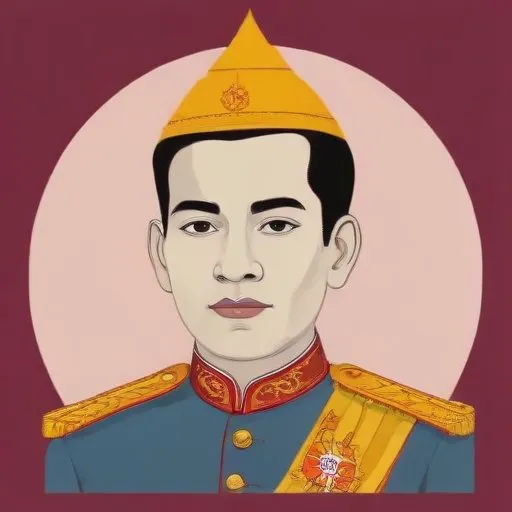
King of Siam from 1809 to 1824, known for his cultural and literary achievements, particularly in poetry and literature. He played a significant role in promoting Thai culture and arts.
Rama II, also known as Phra Phutthaloetla Naphalai, was the second monarch of the Chakri dynasty and ruled Siam (now Thailand) from 1809 to 1824. He is known for his significant contributions to the country's economic growth, cultural development, and military strength.
Born in 1767, Rama II was the son of King Rama I, the founder of the Chakri dynasty. After his father's death, Rama II's brother, Maha Senanurak, was appointed as the regent. However, Rama II seized the throne in 1809, following a power struggle.
Rama II implemented several economic reforms that stimulated Siam's economy. He encouraged trade with China, established a new currency, and developed the country's infrastructure. He also abolished the old system of corvée, a form of forced labor, and introduced a new taxation system.
Under his reign, Siam's economy flourished, and the country became a major trading hub in Southeast Asia. He also promoted the development of agriculture, particularly rice production, which became a staple export of the country.
Rama II was a patron of the arts and encouraged the development of literature, music, and dance. He commissioned the creation of several literary works, including the epic poem, Ramakien, which is still studied in Thailand today.
He also established several temples and educational institutions, including the Wat Phra Kaew temple complex, which became a center of learning and Buddhist studies.
Rama II strengthened Siam's military and maintained good relations with neighboring countries, including Burma and Cambodia. He also established diplomatic relations with the United Kingdom and the Netherlands.
Rama II had 73 children from 42 wives, many of whom went on to play important roles in Siam's politics and society. He died in 1824, and his son, Rama III, succeeded him.
Rama II's legacy is remembered as a period of economic growth, cultural development, and military strength in Siam's history. He is revered as one of the most important monarchs of the Chakri dynasty.
Quote: "The prosperity of the kingdom depends on the prosperity of the people." - Rama II
Rama II's reign marked a significant turning point in Siam's history, and his legacy continues to influence Thai society and culture to this day.
Born in 1804
The 19th-century Thai monarch who modernized and westernized Siam, introducing reforms and diplomatic relations with European powers, while also starring in a Rodgers and Hammerstein musical.
Born in 1853
Reformed Siamese monarchy, introducing Western-style modernization, and abolished slavery. He's credited with saving Siam from European colonization.
Born in 1893
The last absolute monarch of Siam, who ruled from 1925 to 1935 and introduced constitutional monarchy, modernizing the country's government and economy. He's also known for his efforts to promote democracy and social welfare.
Born in 1925
The King of Thailand who introduced modernizing reforms and was a unifying figure during World War II, but tragically died under mysterious circumstances at a young age.
98 Years Old
The monarch who ruled Thailand for over 70 years, earning reverence for his humanitarian work, economic development, and cultural preservation. He was a unifying figure, stabilizing the country during turbulent times.
