


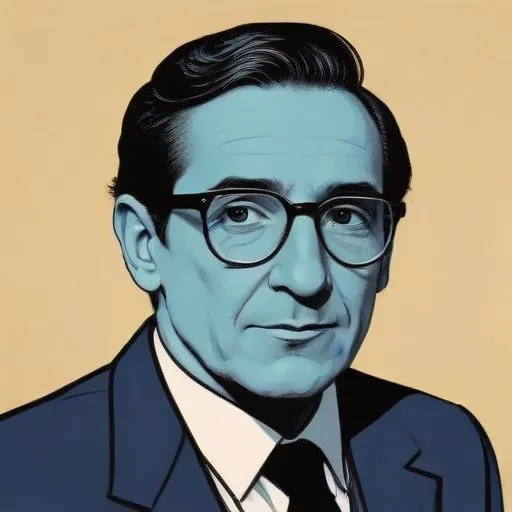
Helped discover the structure of DNA, taking X-ray crystallography photos that contributed to James Watson and Francis Crick's famous model .
Raymond Gosling, a British scientist, is best known for his pivotal role in the discovery of the structure of DNA, working alongside renowned scientists Maurice Wilkins and Rosalind Franklin at King's College, London. His crystalline experimentations and X-ray diffraction images of DNA, though often overshadowed, played a crucial part in James Watson and Francis Crick's development of the double helix model.
Raymond Gosling was born on July 15, 1926, in Wembley, London. He attended school in Wembley and later studied physics at University College, London from 1944 to 1947. Following his undergraduate studies, Gosling worked as a hospital physicist at the King's Fund and Middlesex Hospital between 1947 and 1949. He then joined King's College, London, as a research student, where he eventually earned his PhD.
Gosling's research career took off when he joined King's College, London, under the supervision of Sir John Randall. Randall assigned him to work on the problem of DNA structure, which led Gosling to collaborate with Maurice Wilkins on X-ray diffraction analysis. Gosling's expertise in X-ray diffraction led to the production of the first X-ray diffraction image of crystallized DNA, a groundbreaking achievement that laid the foundation for Watson and Crick's work.
Gosling's partnership with Rosalind Franklin, who joined King's College in 1951, proved to be highly productive. Together, they refined the technique of X-ray diffraction photography of DNA, producing the sharpest diffraction images of DNA at the time. Their collaboration led to the development of the first X-ray diffraction photographs of the wet form B-DNA.
Gosling's work on DNA structure took place during a period of intense scientific competition and discovery. His contributions, though often overlooked, played a vital role in the development of our understanding of DNA. Gosling's story serves as a reminder of the importance of collaboration and the often-overlooked contributions of scientists working behind the scenes.
Gosling passed away on May 18, 2015, leaving behind a legacy of scientific discovery and contributions to our understanding of DNA. Though his work was often eclipsed by his more famous colleagues, Gosling's story remains an inspiration to aspiring scientists and a testament to the power of collaborative research.
Born in 1916
Pioneering scientist who discovered the structure of DNA, revolutionizing our understanding of genetics and life itself.
Born in 1920
A British scientist who contributed significantly to the discovery of the structure of DNA, providing high-quality X-ray crystallography images that helped James Watson and Francis Crick develop their famous model.
Born in 1916
A Nobel Prize-winning physicist and biologist who contributed significantly to the discovery of the structure of DNA, using X-ray crystallography to produce the first clear images of the molecule.
98 Years Old
Discovered the structure of DNA, revolutionizing our understanding of genetics and earning a Nobel Prize. Pioneering work in molecular biology has far-reaching implications for medicine and beyond.
Born in 1901
Pioneering chemist and peace activist who won two unshared Nobel Prizes, one for chemistry and one for peace, for his groundbreaking work on the nature of the chemical bond and his tireless efforts to promote nuclear disarmament.
Born in 1885
A pioneer in quantum mechanics, he introduced the concept of wave-particle duality, revolutionizing our understanding of atomic structure. His philosophical approach to science also explored the nature of reality and human understanding.
Born in 1879
A brilliant physicist who developed the theory of relativity and is considered one of the most influential scientists of the 20th century, known for his groundbreaking work in physics and mathematics.
