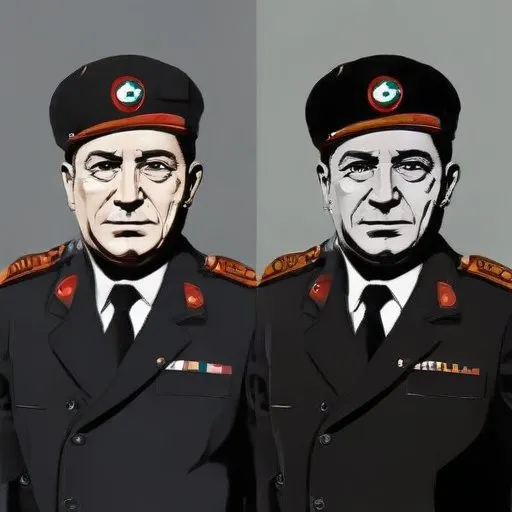
Recep Peker: Turkey's Pragmatic Modernist
Early Life and Military Career
Recep Peker, a Turkish military officer and politician, is best known for serving as the Prime Minister of Turkey, holding various ministerial posts, and playing a crucial role in shaping the country's modern landscape. Born on February 5, 1889, in Istanbul, Peker's father, Mustafa, was of Lezgi descent, hailing from the Dagestan region of the Caucasus.
Peker's educational background was marked by his graduation from the Kuleli Military High School, followed by his enrollment in the Military College. He completed his primary and secondary education at Koca Mustafa Pasha Primary School and Military Middle School. In 1907, he graduated from the Military Academy as a lieutenant and was assigned to the staff officer class.
Military Campaigns and War of Independence
Peker participated in several significant military campaigns, including the battles of Yemen and Libya, the Balkan Wars, and the Thrace and Caucasus campaigns of World War I. He graduated as the first of his class from the Staff College in 1919, where he had enrolled in 1911. During the Turkish War of Independence, Peker served as a squadron leader, joining the movement on February 4, 1920, in Anatolia.
Poliitical Career
Peker's political career began on April 23, 1920, when he was appointed secretary general of the Grand National Assembly of Turkey. He held this position for over three years, during which he also served as the chief of the Second Branch Office at the General Staff. In 1923, he was reelected as the deputy from Kütahya, and went on to hold various ministerial posts, including Minister of Finance, Minister of Interior, Minister of Barter, Minister of Development and Housing, and Minister of National Defence.
Legacy and Impact
Recep Peker's pragmatic modernist approach played a significant role in shaping Turkey's modern landscape. Despite popular misconception, he was not a fascist, but rather a forward-thinking leader who navigated the country through tumultuous times. His legacy continues to influence Turkish politics and society to this day.
Career Highlights
- Prime Minister of Turkey
- Minister of Finance
- Minister of Interior
- Minister of Barter
- Minister of Development and Housing
- Minister of National Defence
Personal Milestones
- Graduated as the first of his class from the Staff College in 1919
- Served as assistant teacher of history of war at the Military Academy
- Joined the Turkish War of Independence in 1920
Historical Context and Legacy
Recep Peker's life and career spanned a tumultuous period in Turkish history, marked by war, independence, and modernization. His legacy continues to be felt in Turkey, and his pragmatic approach to politics serves as an inspiration to leaders and policymakers.
Despite his significant contributions to Turkish politics and society, Peker's life remains somewhat enigmatic, with much of his personal life and beliefs shrouded in mystery. Nonetheless, his impact on Turkish history is undeniable, and his legacy continues to shape the country's future.
FAQ
What was Recep Pekers role in Turkish politics?
Recep Peker was a Turkish officer and politician who served as a key advisor to Mustafa Kemal Atatürk, playing a crucial role in shaping modern Turkeys early years.
How did Recep Pekers military career influence his political views?
Pekers military career, which included fighting in World War I and the Turkish War of Independence, instilled in him a strong sense of nationalism and a commitment to modernizing Turkey.
What was Recep Pekers most significant contribution to Turkish politics?
Pekers most significant contribution was his role in drafting the 1924 Constitution, which established Turkey as a modern, secular republic.
How did Recep Pekers relationship with Atatürk shape his career?
Pekers close relationship with Atatürk, whom he served as a trusted advisor, played a crucial role in his career, earning him influential positions in government and shaping his political views.
What is Recep Pekers legacy in Turkish history?
Pekers legacy is marked by his contributions to Turkeys early development, his role in shaping the countrys constitution, and his commitment to modernizing and secularizing Turkish society.