


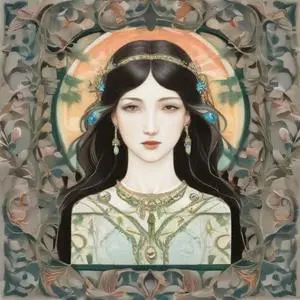
A pioneering artist who revolutionized jewelry design and sculpture with intricate, flowing forms and Art Nouveau style, creating exquisite pieces that blended beauty and functionality.
Ren Lalique, a French jeweller, medallist, and glass designer, is renowned for his exquisite creations of glass art, perfume bottles, vases, jewelry, chandeliers, clocks, and automobile hood ornaments. His innovative designs and techniques revolutionized the art of glassmaking, earning him a reputation as one of the most celebrated artists of the Art Nouveau period.
Born on April 6, 1860, in Ay, France, Lalique's early life was spent learning the methods of design and art that would shape his later career. At the age of two, his family moved to the suburbs of Paris, where they would often take summer holidays in Aÿ, a region that would later influence his naturalistic glasswork.
Lalique's education in design and art began at the Collège Turgot, where he started drawing and sketching at the age of 12. He then attended evening classes at the École des arts décoratifs, where he developed his skills in graphic design and further refined his naturalistic approach to art.
Lalique's career as a designer and artist spanned over five decades, during which he worked as a freelance designer for several French jewelry firms, including Cartier and Boucheron. In 1886, he established his own business, creating innovative designs that showcased his mastery of glass art and jewelry design.
Some of Lalique's most notable works include his iconic perfume bottles, which he designed for prominent perfume houses such as François Coty and Roger & Gallet. These bottles, with their intricate glasswork and delicate designs, have become highly sought-after collectibles.
Lalique's work had a profound impact on modern society, extending beyond the realm of art and design to influence fashion, architecture, and even industry. His innovative use of glass in jewelry design paved the way for a new era of artistic expression, while his designs for perfume bottles and other household items elevated the status of decorative arts.
Lalique's influence can also be seen in the world of architecture, where his designs for ornate glass doors, ceilings, and other decorative elements have been incorporated into many notable buildings, including the famous Opéra Garnier in Paris.
Lalique passed away on May 1, 1945, at the age of 85, leaving behind a legacy that continues to inspire artists, designers, and collectors around the world. He was buried in the Père Lachaise Cemetery in Paris, where many other famous artists and writers are interred.
Lalique's family also played an important role in his legacy, with his daughter, Suzanne Lalique, becoming a talented painter and set designer in her own right. His granddaughter, Marie Claude Lalique, also followed in his footsteps, becoming a skilled glass maker who carried on his tradition of innovative design and craftsmanship.
In conclusion, Ren Lalique was a true master of his craft, whose innovative designs and techniques continue to inspire and influence artists and designers around the world. His legacy is a testament to the power of creativity and imagination, and his work remains a beloved and enduring part of our cultural heritage.
Born in 1848
A renowned artist and designer who pioneered the Art Nouveau style in stained glass, creating exquisite lamps, windows, and jewelry that continue to mesmerize with their vibrant colors and intricate patterns.
Born in 1860
A pioneering artist who revolutionized jewelry design and sculpture with intricate, flowing forms and Art Nouveau style, creating exquisite pieces that blended beauty and functionality.
Born in 1846
A renowned Russian goldsmith and jeweler, famous for creating exquisite, intricate eggs and other ornate objects for the Romanov family and other wealthy patrons. His stunning works of art are still revered for their beauty and craftsmanship today.
Born in 1860
A Czech painter and illustrator renowned for his distinctive Art Nouveau style, characterized by flowing lines, organic forms, and elegant typography, which adorned posters, advertisements, and artworks during the late 19th and early 20th centuries.
Born in 1862
Austrian Symbolist master of opulent, gold-leaf adorned paintings and illustrations that explored the human form, often with erotic undertones. His works are synonymous with Viennese Art Nouveau.
Born in 1868
A pioneering figure in the Glasgow School of Art, this visionary blended elegant lines, flowing curves, and organic forms to create iconic furniture, textiles, and buildings that epitomize Art Nouveau style.
