


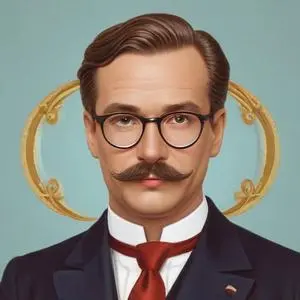
A renowned Russian goldsmith and jeweler, famous for creating exquisite, intricate eggs and other ornate objects for the Romanov family and other wealthy patrons. His stunning works of art are still revered for their beauty and craftsmanship today.
Peter Carl Faberg, a Russian goldsmith and jeweller, is renowned for crafting exquisite eggs that redefine the art of luxury. These eggs, made from precious metals and gemstones, are a testament to his unparalleled craftsmanship and attention to detail.
Born on May 18, 1846, in Saint Petersburg, Russia, Faberg was the son of Gustav Faberg, a Baltic German jeweller of Huguenot descent. His father's jewelry business and artistic inclination instilled in Faberg an appreciation for craftsmanship from a young age.
Faberg received his education at the Dresden Handelsschule trade school, where he studied the basics of business administration. He then embarked on a Grand Tour of Europe, during which he received tuition from respected goldsmiths in Germany, France, and England.
In 1864, Faberg returned to Saint Petersburg and took over his father's jewelry business. He revolutionized the industry with his innovative designs, impeccable craftsmanship, and attention to detail. The House of Faberg soon became synonymous with luxury and elegance.
Faberg's creations were highly sought after by the Russian aristocracy, and his designs won numerous awards at international exhibitions. His reputation as a master craftsman spread far and wide, earning him the title of "Jeweller to the Imperial Court" in 1885.
In 1885, Faberg created the first Imperial Easter Egg, commissioned by Tsar Alexander III as an Easter gift for his wife, Empress Maria Fedorovna. This egg, known as the "Hen Egg," was made from gold, silver, and enamel, and featured a delicate mechanical hen that emerged from the egg.
Over the next 33 years, Faberg created 49 more Imperial Easter Eggs, each one more intricate and breathtaking than the last. These eggs were a testament to his ingenuity, creativity, and skill, and are now considered some of the most valuable and coveted objects in the world.
Faberg's creations have had a profound impact on the world of art, jewelry, and craftsmanship. His innovative designs, attention to detail, and mastery of technique have inspired generations of artists and craftsmen.
Today, Faberg's Imperial Easter Eggs are considered national treasures, with many on display in museums and private collections around the world. His legacy serves as a testament to the power of creativity, innovation, and dedication to one's craft.
Born in 1672
Reformed Russia's government, military, and culture, transforming it into a major European power. Known for modernizing and westernizing the country through numerous reforms and founding St. Petersburg.
Born in 1729
Empress of Russia from 1762 to 1796, she transformed her country into a major European power, modernizing its culture, politics, and economy through numerous reforms and conquests.
Born in 1241
King of Scotland from 1249 to 1286, known for his military campaigns to expand Scotland's borders and his role in the Scottish-Norwegian War.
Born in 1759
The wife of Paul I of Russia, a powerful empress who played a significant role in shaping the country's politics and culture during the late 18th century. She was a patron of the arts and a strong advocate for education and women's rights.
Born in 1870
Founder of the world's first socialist state, leading the Bolshevik Revolution and establishing the Soviet Union, known for his radical Marxist ideology and authoritarian rule.
Born in 1879
Founded the Red Army and played a crucial role in the Russian Revolution, shaping the course of modern communism. A key figure in 20th-century politics and ideology.
Born in 1869
A mystical faith healer who gained immense influence over Russia's royal family, leading to a tumultuous period in the country's history.
