


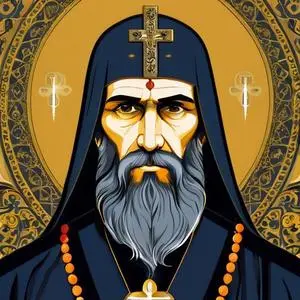
A mystical faith healer who gained immense influence over Russia's royal family, leading to a tumultuous period in the country's history.
Grigori Rasputin, a Russian mystic and faith healer, is best known for his extraordinary influence over the imperial family of Nicholas II, the last Emperor of Russia, during the final years of the Russian Empire. His unique ability to heal and predict the future captivated the royal family, particularly Empress Alexandra Feodorovna, who saw him as a spiritual guide and confidant.
Rasputin was born on January 9, 1869, in the Siberian village of Pokrovskoye, to a family of peasants. Little is known about his early life, but a spiritual conversion experience in 1897, during a pilgrimage to a monastery, changed the course of his life. He became a wanderer, or strannik, traveling Russia and developing a reputation as a mystic and visionary.
In 1903 or 1904, Rasputin arrived in Saint Petersburg, where he quickly gained a following among the city's elite, including high-ranking clergy and noblemen. His charisma, spiritual aura, and supposed healing powers made him a sought-after figure in Russian society. In November 1905, he met Nicholas II and Empress Alexandra, beginning a close relationship that would last over a decade.
Rasputin's unique abilities as a faith healer brought him closer to the royal family, particularly after he began treating Alexei Nikolaevich, the hemophiliac son of Nicholas and Alexandra. His supposed ability to alleviate the boy's suffering endeared him to the imperial family, who saw him as a savior.
As World War I raged on, Nicholas II left Saint Petersburg to oversee the Imperial Russian Army, leaving Rasputin and Empress Alexandra to consolidate their influence over the Russian Empire. Rasputin's power reached an all-time high in 1915, as he became the de facto ruler of Russia, with Alexandra acting as his proxy.
In the early hours of December 30, 1916, a group of conservative Russian noblemen, fearing Rasputin's influence and perceived corruption, assassinated him in a brutal and dramatic fashion. His death marked the beginning of the end of the Romanov dynasty, as the Russian Revolution of 1917 ultimately led to the overthrow and execution of Nicholas II and his family.
Rasputin's relationships with women, including Empress Alexandra and various noblewomen, have been the subject of much speculation and intrigue.
One famous anecdote tells of Rasputin predicting his own death, warning his assassins that if he were killed by nobles, the royal family would soon follow.
Rasputin's life and influence must be understood within the context of the declining Romanov dynasty and the tumultuous years leading up to the Russian Revolution.
Despite his controversial reputation, Rasputin remains a fascinating figure, shrouded in mystery and intrigue, who continues to captivate historians and enthusiasts alike.
Rasputin's extraordinary life serves as a cautionary tale about the dangers of unchecked power, the corrupting influence of wealth and privilege, and the devastating consequences of blind faith.
Born in 1868
The last emperor of Russia, ruling from 1894 to 1917, known for his poor leadership and decisions that led to the downfall of the Romanov dynasty and the rise of communism.
Born in 1870
Founder of the world's first socialist state, leading the Bolshevik Revolution and establishing the Soviet Union, known for his radical Marxist ideology and authoritarian rule.
Born in 1878
The Soviet Union's ruthless leader who ruled with an iron fist, implementing policies that led to widespread famine and purges, while also playing a crucial role in defeating Nazi Germany in World War II.
Born in 1879
Founded the Red Army and played a crucial role in the Russian Revolution, shaping the course of modern communism. A key figure in 20th-century politics and ideology.
95 Years Old
First President of Russia, leading the country's transition from communism to democracy, and known for his bold reforms and iconic leadership style.
95 Years Old
The last leader of the Soviet Union, who introduced reforms that led to the end of the Cold War and the collapse of communism, earning a Nobel Peace Prize. He's known for his policies of glasnost and perestroika, which transformed the Soviet Union and the world.
74 Years Old
A Russian politician who has dominated the country's politics for over two decades, known for his authoritarian leadership style and controversial foreign policy decisions.
