


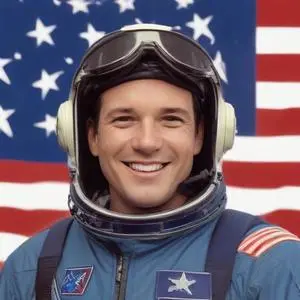
A decorated naval aviator and astronaut who flew on the Gemini 11 and Apollo 12 missions, playing a crucial role in the early space exploration era.
Richard Francis "Dick" Gordon Jr. is renowned for being one of only 24 people to have flown to the Moon, making him a pioneer in the field of space exploration. As the command module pilot of the Apollo 12 mission, he bravely orbited the Moon 45 times, cementing his place in the annals of space history.
Gordon was born on October 5, 1929, in Seattle, Washington, to Richard Francis Gordon Sr. and Angela Frances Gordon (née Sullivan). The eldest of five children, Gordon grew up with a strong sense of adventure and curiosity. He was an active Boy Scout, earning the rank of Star Scout, and later graduated from North Kitsap High School in Poulsbo, Washington, in 1947. He went on to earn a Bachelor of Science degree in chemistry from the University of Washington in 1951, where he was also a member of Phi Sigma Kappa fraternity.
After graduating from college, Gordon joined the United States Navy, earning his wings as a Naval Aviator in 1953. He attended All-Weather Flight School and jet transitional training, before being assigned to an all-weather fighter squadron at Naval Air Station Jacksonville, Florida. In 1957, he attended the United States Naval Test Pilot School at Naval Air Station Patuxent River, Maryland, where he served as a flight test pilot until 1960. During this period, he worked on various aircraft, including the F8U Crusader, F11F Tiger, North American FJ Fury, and A4D Skyhawk, and was the first project test pilot for the F4H-1 Phantom II.
Gordon's experience as a test pilot and naval aviator prepared him for his next great challenge: space exploration. In 1966, he flew as the pilot of the Gemini 11 mission, during which he spent over three days in space, orbiting the Earth 44 times. This experience laid the groundwork for his later mission as command module pilot of Apollo 12, which launched on November 14, 1969. During this mission, Gordon orbited the Moon 45 times, while his fellow astronauts, Pete Conrad and Alan Bean, made history by walking on the lunar surface.
Gordon's contributions to the field of space exploration were recognized with numerous awards and honors, including the NASA Distinguished Service Medal, the Navy Distinguished Service Medal, and the Legion of Merit. He was also inducted into the National Aviation Hall of Fame, the International Air & Space Hall of Fame, and the U.S. Astronaut Hall of Fame.
Gordon retired from the Navy in 1972, with the rank of captain. He went on to work as a football executive, serving as the general manager of the New Orleans Saints from 1978 to 1981. Gordon passed away on November 6, 2017, at the age of 88, leaving behind a legacy as one of the pioneers of space exploration.
Richard F. Gordon Jr.'s remarkable life and achievements serve as an inspiration to anyone who has ever looked up at the stars and wondered what lies beyond. His bravery, skill, and dedication to the pursuit of space exploration have earned him a permanent place in the history books, and his legacy will continue to inspire future generations of astronauts and explorers.
Born in 1923
First American in space, commanded Apollo 14 mission, and walked on the Moon.
98 Years Old
American baseball player who pitched in the Major Leagues from 1965 to 1975, known for being a four-time All-Star and winning the American League ERA title in 1968.
96 Years Old
First person to walk on the Moon during the Apollo 11 mission, marking a historic milestone in space exploration.
96 Years Old
Second man to walk on the Moon during the Apollo 11 mission, a pioneering astronaut and advocate for space exploration.
96 Years Old
Led the third manned mission to land on the Moon, Apollo 12, and became the third person to walk on its surface. Known for his bold and fearless approach to space exploration.
Born in 1926
One of the original seven astronauts in NASA's Project Mercury, a decorated military pilot, and a pioneer in space exploration, known for being the second American in space and commanding the first manned Gemini mission.
Born in 1923
One of the original seven astronauts in Project Mercury, this pioneer flew on three historic spaceflights, including the first American manned orbital flight and the Apollo 7 mission.
Born in 1924
One of the original Mercury Seven astronauts, he was a decorated war veteran and test pilot who later became a NASA executive, playing a crucial role in the development of the US space program.
