


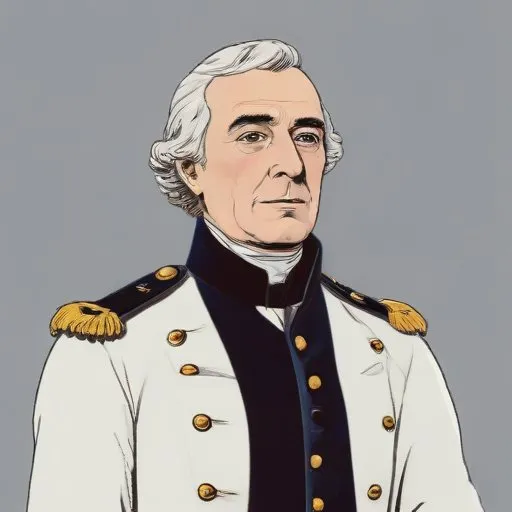
A British naval officer who served as the Commodore-Governor of Newfoundland, known for his role in the French Revolutionary Wars and his contributions to the development of the colony. He played a key role in establishing trade and commerce in the region.
Admiral Sir Richard Goodwin Keats is remembered as one of the most capable and respected officers in the British Navy, having fought valiantly throughout the American Revolution, French Revolutionary War, and Napoleonic War. His bravery and tactical prowess at the Battle of Algeciras Bay have become the stuff of legend, cementing his place in the annals of naval history.
Keats was born on January 16, 1757, at Chalton, Hampshire, to Reverend Richard Keats, the curate of Bideford and Kings Nympton in Devon, and his wife, Elizabeth. Despite a brief formal education, which included stints at New College School, Oxford, and Winchester College, Keats lacked scholastic aptitude and instead set his sights on a career in the Royal Navy.
In 1770, Keats entered the navy as a midshipman aboard the 74-gun HMS Bellona, under the command of Captain John Montagu. He would follow Montagu when he was promoted to rear admiral and given command of the North American Station and the governorship at Halifax. Keats served on several ships on the Newfoundland Station, including those under the command of his patron and his patron's son, Captain James Montagu.
In April 1777, Keats was promoted to lieutenant under Captain Robert Digby in HMS Ramillies, in which he participated in the First Battle of Ushant on July 27, 1778. As a member of Digby's circle, he was moved with him to the second-rate, 90-gun HMS Prince George. It was during this time that Keats formed a lifelong friendship with Prince William Henry, later William IV, who served as a midshipman on Prince George for nearly two years. The prince would later credit Keats as the one to whom he owed his professional knowledge.
Keats' most notable achievement came during the Battle of Algeciras Bay, where his tactical prowess and bravery played a crucial role in the British victory. His actions during the battle have become legendary, solidifying his reputation as a capable and respected officer.
In 1812, Keats retired from active duty due to ill health, but was appointed Commodore-Governor of Newfoundland from 1813 to 1816. In 1821, he was made Governor of Greenwich Hospital in Greenwich, London, a position he held until his death on April 5, 1834.
Admiral Sir Richard Goodwin Keats' legacy continues to inspire and captivate naval historians and enthusiasts alike, his bravery and tactical prowess at the Battle of Algeciras Bay remaining an enduring testament to his skills as a naval officer.
Born in 1738
The British monarch who ruled during the American Revolution, losing the colonies, and later suffered a mental illness that led to a regency crisis. He's also known for his cultural and artistic patronage.
Born in 1759
Prime Minister of the United Kingdom from 1783 to 1801 and 1804 to 1806, known for leading the country through the French Revolutionary and Napoleonic Wars.
Born in 1770
A skilled lawyer and politician who served as Prime Minister of the United Kingdom, known for his strong oratory skills and brief but influential tenure in office.
