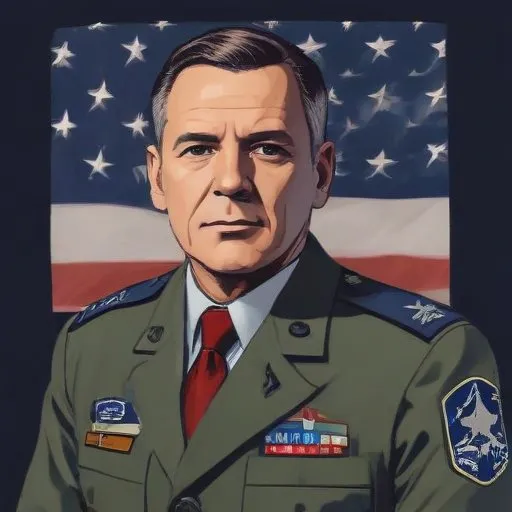
Richard O. Covey: The Astronaut with a Legacy Beyond the Stars
Astral Achievements
Richard O. Covey is a name synonymous with courage, skill, and determination. As a retired United States Air Force officer, former NASA astronaut, and member of the United States Astronaut Hall of Fame, Covey has left an indelible mark on the world of space exploration. With a staggering four space flights under his belt, Covey has spent over 646 hours in space, making him a pioneer in the field of astronautics.
Early Life and Education
Born on August 1, 1946, in Fayetteville, Arkansas, Covey considers Fort Walton Beach, Florida, his hometown. He graduated from Choctawhatchee High School in Fort Walton Beach in 1964 and went on to earn a Bachelor of Science degree in Engineering Science with a major in Astronautical Engineering from the United States Air Force Academy in 1968. Covey further honed his skills by earning a Master of Science degree in Aeronautics and Astronautics from Purdue University in 1969.
Military Career
As a member of the U.S. Air Force, Covey served as an operational fighter pilot from 1970 to 1974, flying the F100 Super Sabre, A7 Dragonfly, and A7 Corsair II. During his two tours in Southeast Asia, he flew an impressive 339 combat missions. Later, at Eglin Air Force Base, Florida, Covey was an F4 Phantom II and A7D weapons system test pilot and joint test force director for electronic warfare testing of the F15 Eagle. Throughout his military career, Covey accumulated over 5,700 hours of flight experience in more than 30 different types of aircraft.
NASA Career
Selected as an astronaut candidate by NASA in January 1978, Covey became an astronaut in August 1979. His impressive spaceflight history includes:
- STS-51I in 1985
- STS-26 in 1988
- STS-38 in 1990
- STS-61 in 1993
Before his first spaceflight, Covey provided astronaut support in Orbiter engineering development and testing. He was also a T38 chase pilot for the second and third Shuttle flights and support crewman for the first operational Shuttle flight, STS-5. Covey's voice is famously remembered as the one that uttered the words "Challenger, go at throttle up" shortly before the tragic Challenger disaster.
Legacy and Impact
Richard O. Covey's exemplary career has inspired generations of astronauts, engineers, and scientists. His contributions to the field of astronautics are immeasurable, and his legacy continues to inspire new generations of space explorers. As a testament to his outstanding achievements, Covey was inducted into the United States Astronaut Hall of Fame in 2008.
Personal Milestones and Key Life Events
Throughout his remarkable career, Covey has achieved numerous personal milestones, including:
- Flying over 5,700 hours in more than 30 different types of aircraft
- Logging over 646 hours in space
- Flying 339 combat missions in Southeast Asia
These impressive accomplishments are a testament to Covey's unwavering dedication, hard work, and unrelenting passion for space exploration.
Philosophical Contributions and Beliefs
Covey's experience as an astronaut has given him a unique perspective on life and the universe. He believes that space exploration is not only a means to expand our knowledge but also a way to inspire future generations to strive for excellence.
"The vastness of space is a reminder of how small we are, yet it's also a testament to human ingenuity and our ability to push beyond the boundaries of what's thought possible."
This philosophy has guided Covey's work and continues to inspire those who follow in his footsteps.
Influence on Modern Society
Richard O. Covey's contributions to space exploration have had a profound impact on modern society. His work has paved the way for future generations of astronauts, engineers, and scientists. His legacy continues to inspire new technologies, innovations, and discoveries that shape our world today.
FAQ
What is Richard O. Coveys background as an astronaut?
Richard O. Covey is a retired American astronaut who flew on four Space Shuttle missions, logging over 646 hours in space. Born on August 1, 1946, in Fayetteville, Arkansas, Covey earned a Bachelor of Science degree in Engineering Physics from the United States Air Force Academy in 1968.
What awards did Richard O. Covey receive for his service?
Richard O. Covey received numerous awards for his service, including the Defense Superior Service Medal, the Legion of Merit, and the NASA Distinguished Service Medal. He was also inducted into the United States Astronaut Hall of Fame in 2013.
What was Richard O. Coveys role in the Space Shuttle program?
As a pilot and astronaut, Richard O. Covey played a crucial role in the Space Shuttle program. He served as the commander of STS-51G, which launched on June 17, 1985, and was responsible for deploying three satellites into orbit.
How did Richard O. Coveys military service prepare him for his career as an astronaut?
Richard O. Coveys military service as a colonel in the United States Air Force prepared him for his career as an astronaut. His experience as a fighter pilot and test pilot helped him develop the skills and expertise needed to fly on the Space Shuttle.
What is Richard O. Coveys legacy in the space exploration community?
Richard O. Coveys legacy in the space exploration community is one of dedication and service. He has inspired countless individuals to pursue careers in space exploration and has contributed significantly to our understanding of space travel.