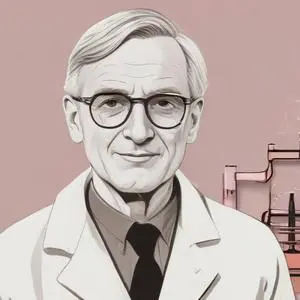
Richard R. Ernst: The Nobel Laureate Who Revolutionized NMR Spectroscopy
The Father of Fourier Transform NMR
Richard R. Ernst is renowned for his groundbreaking contributions to the development of Fourier transform nuclear magnetic resonance (NMR) spectroscopy, a technique that has transformed the fields of chemistry and medicine. Awarded the Nobel Prize in Chemistry in 1991, Ernst's work has enabled the creation of high-resolution NMR spectra, paving the way for significant advances in structural biology, medicine, and materials science.
A Humble Beginnings
Born on August 14, 1933, in Winterthur, Switzerland, Ernst was the oldest of three children to Robert Ernst and Irma Ernst-Brunner. Growing up in a house built by his grandfather, Ernst was surrounded by the sounds of music, playing the violoncello and even considering a career as a musical composer. However, it was his chance discovery of a box of chemicals belonging to his late uncle, a metallurgical engineer, at the age of 13 that set him on a path towards a life of scientific discovery.
Education and Early Research
Ernst enrolled in the Eidgenössische Technische Hochschule (ETH) in Zurich, where he studied chemistry and received his diploma in 1957 as a Diplomierter Ingenieur Chemiker. Disappointed with the course content, Ernst took it upon himself to learn quantum mechanics and thermodynamics in his spare time. After completing his military service, Ernst earned his Ph.D. in physical chemistry in 1962 from ETH Zurich, with a dissertation on nuclear magnetic resonance in physical chemistry.
A Career of Innovation
Ernst's career was marked by a series of innovative breakthroughs that would change the face of NMR spectroscopy. He entered Varian Associates as a scientist in 1963, where he invented Fourier transform NMR, noise decoupling, and other methods. Returning to ETH Zurich in 1968, Ernst became a lecturer, eventually rising to the ranks of assistant professor in 1970 and associate professor in 1976. His work at ETH Zurich focused on the development of new NMR techniques and their applications in chemistry and biology.
Awards and Honors
Ernst's pioneering work in NMR spectroscopy has been recognized with numerous awards and honors, including the Nobel Prize in Chemistry in 1991. He was also awarded the Marcel Benoist Prize in 1985 and the Wolf Prize in Chemistry in 1991.
Legacy and Impact
Ernst's legacy extends far beyond his own achievements. His work has enabled the development of magnetic resonance imaging (MRI) technology, revolutionizing the field of medicine. His contributions to NMR spectroscopy have also had a profound impact on the fields of structural biology, materials science, and chemistry. As a testament to his influence, Ernst's work has inspired generations of scientists, ensuring that his legacy will continue to shape the scientific landscape for years to come.
In His Own Words
"I humbly refer to myself as a toolmaker rather than a scientist."
— Richard R. Ernst
FAQ
What is Richard R. Ernsts most notable achievement?
Richard R. Ernst was awarded the Nobel Prize in Chemistry in 1991 for his work on the development of Fourier transform nuclear magnetic resonance (NMR) spectroscopy. This technique has had a profound impact on the field of chemistry and has enabled the study of complex molecular structures.
What is the significance of Fourier transform NMR spectroscopy?
Fourier transform NMR spectroscopy is a technique that allows scientists to study the structure of molecules at the atomic level. It has applications in fields such as chemistry, biology, and medicine, and has enabled numerous breakthroughs in our understanding of molecular structures and interactions.
What is Richard R. Ernsts background?
Richard R. Ernst was born in 1933 in Winterthur, Switzerland. He earned his Ph.D. in chemistry from ETH Zurich and went on to work at Varian Associates and then as a professor at ETH Zurich.
What other awards has Richard R. Ernst won?
In addition to the Nobel Prize, Richard R. Ernst has won numerous other awards for his work, including the Marcel Benoist Prize, the Kirkwood Medal, and the Wolf Prize in Chemistry.
What is Richard R. Ernsts legacy?
Richard R. Ernsts work on Fourier transform NMR spectroscopy has had a profound impact on the field of chemistry and has enabled numerous breakthroughs in our understanding of molecular structures and interactions. He is widely regarded as one of the most important chemists of the 20th century.