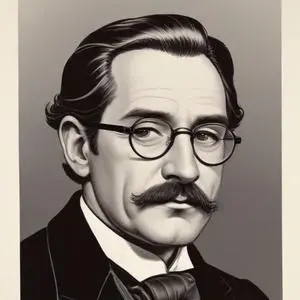
RICHARD VON KRAFFT-Ebing: The Pioneer of Sexual Psychology
The Foundational Work: Psychopathia Sexualis
Richard von Krafft-Ebing is renowned for his groundbreaking work,
Psychopathia Sexualis, a monumental treatise that laid the foundation for the study of sexual psychology. Published in 1886, this seminal work revolutionized the field of psychiatry, providing a comprehensive understanding of human sexuality and its various manifestations.
Early Life and Education
Born on August 14, 1840, in Mannheim, Grand Duchy of Baden, Richard von Krafft-Ebing was the eldest of five children to Friedrich Karl Konrad Christoph von Krafft-Ebing, a high-ranking official, and Klara Antonia Carolina, a daughter of the renowned legal scholar Carl Joseph Anton Mittermaier. His paternal lineage was ennobled in 1770 by Empress Maria Theresia, and elevated to baronial status in 1805 by Emperor Franz II.
Von Krafft-Ebing pursued his education at Ruprecht-Karls-University Heidelberg, where he earned his Doctorate in Medicine in 1863 with a thesis on Sensory Delusions. During his studies, he became a member of Burschenschaft Frankonia Heidelberg, a prestigious student fraternity.
Medical Career and Contributions
After recovering from typhoid, von Krafft-Ebing spent a summer in Zurich, where he became acquainted with Wilhelm Griesinger's brain anatomical studies. He then pursued practical experience in the treatment and care of the mentally ill and those suffering from neurological disorders at the Baden mental hospital Illenau from 1864 to 1868. During this period, he worked under Christian Roller and Karl Hergt, gaining valuable insights into the complexities of mental health.
In 1867, von Krafft-Ebing published his paper, "Recognition of Doubtful Mental States," which showcased his innovative approach to psychiatric diagnosis. His work in this field led to the development of new methods for understanding and treating mental illnesses.
(In) Famous Works and Controversies
Psychopathia Sexualis, von Krafft-Ebing's magnum opus, was initially met with controversy and censure. The book's explicit content and frank discussions of human sexuality were deemed scandalous by many, leading to its initial ban in Austria. However, this scandal only added to the book's notoriety, and it soon became a bestseller, going through multiple editions.
The work's impact was not limited to the medical community; it also influenced literary and artistic circles. Von Krafft-Ebing's ideas on sexuality and deviance inspired authors like
Oscar Wilde and
Robert Louis Stevenson, who incorporated elements of his theories into their works.
Influence on Modern Society
Von Krafft-Ebing's work laid the groundwork for modern sexology, influencing thinkers like
Sigmund Freud and Havelock Ellis. His ideas on sexual psychology and deviance continue to influence contemporary debates on gender, sexuality, and identity.
Moreover, von Krafft-Ebing's emphasis on the significance of forensic psychiatry paved the way for modern approaches to criminal psychology and the intersection of law and psychiatry.
Legacy
Richard von Krafft-Ebing's pioneering work in sexual psychology has left an indelible mark on modern society. His fearless exploration of human sexuality and his commitment to understanding the complexities of the human mind have made him a legendary figure in the annals of psychiatric history.
As we reflect on von Krafft-Ebing's remarkable contributions, we are reminded of the power of human curiosity and the importance of pushing boundaries in the pursuit of knowledge. His groundbreaking work continues to inspire new generations of scholars, researchers, and thinkers, ensuring his legacy as a true pioneer in the field of sexual psychology.
FAQ
What was Richard von Krafft-Ebings area of expertise?
Richard von Krafft-Ebing was a German-Austrian psychologist and author who made significant contributions to the fields of psychiatry and sexology. He is best known for his work on forensic psychology and deviant sexual behavior.
What is Richard von Krafft-Ebings most famous work?
Richard von Krafft-Ebings most famous work is Psychopathia Sexualis, a comprehensive treatise on sexual deviance and abnormal behavior. The book is still studied by scholars and researchers today.
How did Richard von Krafft-Ebings work impact the field of psychology?
Richard von Krafft-Ebings work had a profound impact on the field of psychology, particularly in the areas of forensic psychology and sexology. His research and writings helped establish these fields as legitimate areas of study.
Did Richard von Krafft-Ebing have any notable students?
Yes, Richard von Krafft-Ebing taught and mentored several prominent psychologists and psychiatrists, including Sigmund Freud. His students went on to make significant contributions to the field of psychology.
Is Richard von Krafft-Ebings work still relevant today?
Yes, Richard von Krafft-Ebings work on forensic psychology and sexology remains relevant today, and his ideas continue to influence research in these fields.