


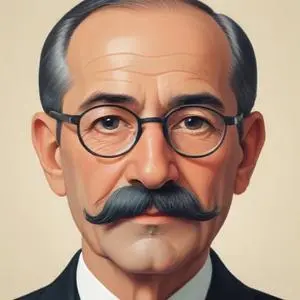
Founded a multinational engineering and technology company that specializes in automotive systems, industrial technology, and consumer goods, revolutionizing industries with innovative solutions.
Robert Bosch, a German industrialist, engineer, and inventor, is renowned for revolutionizing the automotive industry with his pioneering work on spark plugs and ignition systems. As the founder of Robert Bosch GmbH, he laid the foundation for a global company that has been at the forefront of innovation for over 130 years.
Born on September 23, 1861, in Albeck, Germany, Bosch was the youngest of twelve children to Servatius and Maria Margarita Bosch. Growing up on a progressive farm that included a brewery, Bosch developed a strong work ethic and an innate curiosity that would shape his future endeavors.
After completing his education at the Realanstalt in Ulm, Bosch underwent an apprenticeship as a precision instrument maker, followed by stints as a journeyman at C. E. Fein and Schuckert & Co. In 1883, he fulfilled his military service in Ulm, and subsequently studied under Professor Wilhelm Dietrich at the Stuttgart Technical University.
In 1884, Bosch sailed to the United States, where he worked as an engineer under Thomas Edison and Sigmund Bergmann in New York. This experience not only honed his skills but also instilled in him a passion for innovation. Bosch's American sojourn played a significant role in shaping his future entrepreneurial endeavors.
In 1886, Bosch returned to Stuttgart, where he established his own Workshop for Precision Mechanics and Electrical Engineering. This marked the beginning of Robert Bosch GmbH, which would go on to become a global giant in the automotive and industrial sectors.
In 1887, Gottlieb Daimler approached Bosch to develop a low-voltage magneto device with firing points for his four-stroke engine. Bosch's innovative solution led to the creation of the first high-voltage spark plug, revolutionizing the automotive industry.
Bosch's invention of the spark plug marked a turning point in his career. Over the next few years, he built hundreds of units for factories making gas motors. In 1893, Frederick Richard Simms approached Bosch to adapt his stationary engine magnetos for motor vehicles, paving the way for the development of the first electric starter motor.
Bosch's dedication to innovation and quality earned him numerous accolades, including the Grand Prix at the 1900 World's Fair in Paris. His spark plug design continued to evolve, and by the 1920s, it had become an industry standard.
Bosch's commitment to innovation and quality was underpinned by his philosophical approach to business and life. He believed in the importance of fostering a strong company culture, investing in employee development, and promoting social responsibility. These values continue to guide Robert Bosch GmbH to this day.
Robert Bosch's contributions to the automotive industry are immeasurable. His pioneering work on spark plugs and ignition systems paved the way for the development of modern vehicles. Today, Robert Bosch GmbH is a global leader in the automotive and industrial sectors, employing over 400,000 people worldwide.
Bosch's legacy extends beyond the automotive industry. He was a true visionary who embodied the spirit of innovation and entrepreneurship. His story serves as an inspiration to generations of inventors, engineers, and entrepreneurs, reminding us that with dedication, perseverance, and a passion for excellence, we can create a lasting impact on the world.
Robert Bosch's remarkable journey serves as a testament to the power of innovation, perseverance, and dedication. His legacy continues to inspire and shape the world around us, reminding us that even the smallest spark of innovation can ignite a revolution.
Born in 1834
Co-founder of the first high-speed internal combustion engine and the company that bears his name, revolutionizing the automotive industry with innovative designs and manufacturing techniques.
Born in 1846
Founded the luxury car brand Maybach, known for designing and building high-performance engines and exclusive vehicles. His innovative designs and precision engineering set a new standard for the automotive industry.
Born in 1921
A talented actor who brought iconic characters to life on TV, starring in popular sitcoms like "The Donna Reed Show" and "Judd for the Defense".
Born in 1834
Co-founder of the first high-speed internal combustion engine and the company that bears his name, revolutionizing the automotive industry with innovative designs and manufacturing techniques.
Born in 1875
Designed iconic sports cars, including the Volkswagen Beetle, and founded a legendary company that bears his name, synonymous with speed and luxury.
Born in 1912
Developed the V-2 rocket for Nazi Germany and later led the team that created the Saturn V rocket that took humans to the moon.
Born in 1858
A German engineer who invented the Diesel engine, a revolutionary internal combustion engine that transformed the industrial landscape. This innovation enabled more efficient and powerful machines, shaping modern transportation and industry.
