


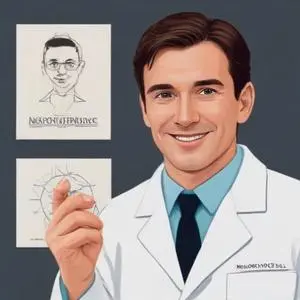
Developed the first synthetic approach to making proteins, earning a Nobel Prize in Chemistry in 1984 for his groundbreaking work in peptide synthesis.
Robert Bruce Merrifield, a trailblazing American biochemist, revolutionized the field of chemistry by inventing solid phase peptide synthesis, a groundbreaking technique that earned him the Nobel Prize in Chemistry in 1984. This pioneering method enabled the efficient production of peptides and proteins, paving the way for significant advancements in biomedical research and drug development.
Born on July 15, 1921, in Fort Worth, Texas, Merrifield was the only son of George E. Merrifield and Lorene nee Lucas. The family's move to California in 1923 sparked Merrifield's interest in chemistry and astronomy during his formative years. He attended nine grade schools and two high schools before graduating from Montebello High School in 1939.
Merrifield's academic journey took him to Pasadena Junior College, followed by the University of California, Los Angeles (UCLA), where he graduated with a degree in chemistry. A year-long stint at the Philip R. Park Research Foundation, working with an animal colony and assisting with growth experiments on synthetic amino acid diets, further solidified his research skills. Merifield's return to UCLA's chemistry department led to his collaboration with Professor M.S. Dunn, where he developed microbiological methods for quantitating pyrimidines.
The day after graduating on June 19, 1949, Merrifield married Elizabeth Furlong, and the couple set off for New York City, where Merrifield began his research career at the Rockefeller Institute for Medical Research. As an assistant to Dr. D.W. Woolley, Merrifield worked on dinucleotide growth factors and peptide growth factors, laying the groundwork for his future breakthrough.
In 1959, Merrifield's research took a pivotal turn. Frustrated with the limitations of traditional peptide synthesis methods, he conceived the idea of solid phase peptide synthesis (SPPS). This innovative approach allowed for the efficient and rapid production of peptides and proteins, revolutionizing the field of biochemistry. Merrifield's 1963 paper in the Journal of the American Chemical Society, detailing the SPPS method, became a seminal work, earning its place as the fifth most cited paper in the journal's history.
Robert Bruce Merrifield's pioneering work in solid phase peptide synthesis has had a profound impact on the fields of biochemistry, molecular biology, and medicine. His invention has enabled the development of new drugs, therapies, and diagnostic tools, improving the lives of countless individuals worldwide. As a testament to his legacy, Merrifield's work continues to inspire new generations of scientists, ensuring a brighter future for humanity.
Born in 1901
Pioneering chemist and peace activist who won two unshared Nobel Prizes, one for chemistry and one for peace, for his groundbreaking work on the nature of the chemical bond and his tireless efforts to promote nuclear disarmament.
98 Years Old
Discovered the structure of DNA, revolutionizing our understanding of genetics and earning a Nobel Prize. Pioneering work in molecular biology has far-reaching implications for medicine and beyond.
Born in 1916
Pioneering scientist who discovered the structure of DNA, revolutionizing our understanding of genetics and life itself.
Born in 1920
A British scientist who contributed significantly to the discovery of the structure of DNA, providing high-quality X-ray crystallography images that helped James Watson and Francis Crick develop their famous model.
Born in 1916
A Nobel Prize-winning physicist and biologist who contributed significantly to the discovery of the structure of DNA, using X-ray crystallography to produce the first clear images of the molecule.
Born in 1918
Developed techniques for sequencing DNA and proteins, revolutionizing molecular biology and earning two Nobel Prizes in Chemistry.
Born in 1905
A pioneer in DNA research, this biochemist discovered the base pairing rules of DNA, leading to a fundamental understanding of genetic code.
Born in 1905
A pioneering biochemist who discovered the mechanism of RNA synthesis, earning a Nobel Prize in Physiology or Medicine in 1959. His work laid the foundation for our understanding of genetic code and protein synthesis.
