


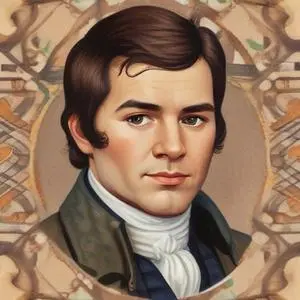
Celebrated for his poignant and lyrical poetry, he penned iconic works that capture the essence of Scottish culture and identity. His contributions to literature continue to inspire and delight readers worldwide.
Robert Burns, Scotland's national poet, is renowned for his poignant and evocative works that capture the essence of love, nature, and humanity. Through his poetry and songs, Burns has left an indelible mark on Scottish literature, earning him the title of "The Bard of Ayrshire."
Born on January 25, 1759, in Alloway, Ayrshire, Scotland, Burns was the eldest of seven children to William and Agnes Burns. His early life was shaped by the rugged Scottish countryside and the struggles of his family's tenant farm. Despite the hardships, Burns' parents recognized his love for learning and encouraged his education.
Burns' earliest forays into poetry were inspired by Scottish folklore and the works of Robert Fergusson. His own writing style, characterized by simple yet powerful language, began to take shape in his teenage years. Alongside poetry, Burns was an accomplished musician and fiddler, often incorporating traditional Scottish tunes into his works.
Burns' poetry and songs have had a profound impact on Scottish identity, with his works often serving as a voice for the common people. His legacy extends beyond literature, with his birthday, January 25, celebrated as Burns Night, a festive occasion marked by traditional Scottish food, drink, and music.
In 1788, Burns married Jean Armour, and the couple had nine children together. His personal life was marked by struggles with poverty, health issues, and a passion for women, which often led to tumultuous relationships.
Burns' poetry and songs have inspired countless generations of writers, musicians, and artists. His legacy extends beyond Scotland, with his works translated into numerous languages and admired worldwide.
Today, Robert Burns remains an integral part of Scottish culture, and his poetry continues to captivate readers with its beauty, wit, and emotional depth. As we celebrate the life and legacy of this remarkable poet, we are reminded of the power of art to transcend time and touch the human heart.
Born in 1919
The charismatic leader who championed Canadian unity and implemented progressive policies, known for his iconic style and influential legacy in shaping modern Canada.
92 Years Old
The 20th Prime Minister of Canada, serving from 1993 to 2003, known for his leadership during the Quebec sovereignty movement and his role in shaping Canada's national unity. He implemented policies like the Clarity Act and the National Child Benefit.
87 Years Old
The 18th Prime Minister of Canada, a skilled lawyer and politician, led the country from 1984 to 1993, known for negotiating the Canada-US Free Trade Agreement and introducing the Goods and Services Tax.
79 Years Old
The first and only female Prime Minister of Canada, serving for a brief four months in 1993, known for her efforts to reform the country's justice system. She was also a strong advocate for women's rights and gender equality.
97 Years Old
The 17th Prime Minister of Canada, serving from 1984 to 1985, is most known for his brief tenure and struggles to maintain party unity. He's also recognized for his prior role as Minister of Justice, where he introduced significant reforms.
87 Years Old
The 16th Prime Minister of Canada, serving from 1979 to 1980, is known for being a Progressive Conservative and leading a brief but significant term in Canadian politics. He's also a journalist and politician who played a key role in shaping Canada's foreign policy.
Born in 1895
The 13th Prime Minister of Canada, a champion of individual rights and freedoms, introduced the Canadian Bill of Rights, a precursor to the Charter of Rights and Freedoms. He's also known for his anti-apartheid stance and leadership during the Suez Crisis.
Born in 1897
A Canadian leader who served as Prime Minister and won the Nobel Peace Prize for resolving the Suez Canal Crisis, known for his diplomatic efforts and peacekeeping initiatives.
