


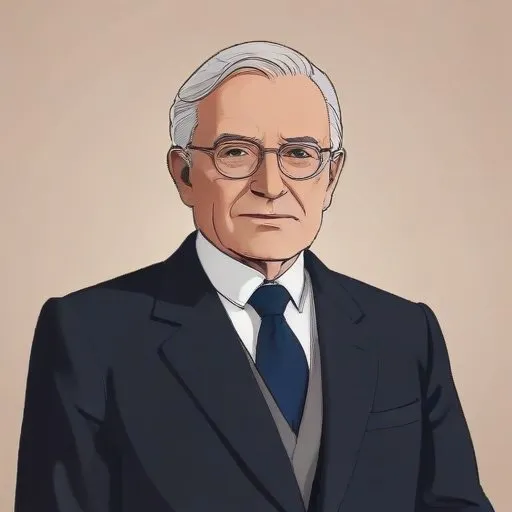
A 17th-century English engineer and politician who served as Lord President of the Council, known for his contributions to the development of the British monarchy's administrative system. He played a key role in shaping the country's governance during a tumultuous period.
Robert Carr, Baron Carr of Hadley, was a British Conservative Party politician who left an indelible mark on the UK's industrial landscape as Home Secretary from 1972 to 1974. He is perhaps best known for his instrumental role in shaping the Industrial Relations Act 1971, a landmark legislation that aimed to balance employee rights with curbs on the freedom to strike.
Born on November 11, 1916, in North Finchley, Carr was educated at Westminster School and Gonville and Caius College, Cambridge, where he graduated in Natural Sciences in 1938. His early career was marked by a stint at John Dale & Co, the family metal engineering firm, where he applied his knowledge of metallurgy.
Although a collapsed lung prevented him from serving in World War II, Carr's firm contributed to the war effort by specializing in the construction of airframes for Lancaster bombers. In 1943, he married Joan Twining, and they had a son and two daughters. Tragedy struck the family in 1965 when their son, David, died in a traffic accident.
Carr's foray into politics began in 1950 when he was elected Member of Parliament for Mitcham. He served in this capacity until 1974, when the seat was merged, and he moved to Carshalton. As a parliamentary private secretary to Anthony Eden from 1951 to 1955, Carr honed his skills, eventually becoming a parliamentary secretary to the labour ministry.
Carr's crowning achievement was the Industrial Relations Act 1971, which he introduced as Secretary of State for Employment. This legislation aimed to strike a balance between employee rights and employer interests, introducing compensation for unfair dismissal while curtailing the freedom to strike and phasing out closed shop agreements.
The Industrial Relations Act 1971 was met with fierce resistance from trade unions, who saw it as an attack on their rights. The ensuing industrial action led to the infamous three-day week and ultimately contributed to the defeat of the government. Despite the controversy, Carr's legacy as a champion of industrial relations endures.
In 1974, Carr was appointed to the House of Lords as a life peer, becoming Baron Carr of Hadley. Throughout his distinguished career, he received several honors, including a knighthood in 1970. Robert Carr passed away on February 17, 2012, leaving behind a complex legacy that continues to shape the UK's industrial landscape.
"The Industrial Relations Act is not an attack on the trade unions, but an attempt to create a fairer and more just system for all."
Born in 1885
Won the 1952 Olympic Games marathon in Helsinki, Finland, and held the world record in the marathon from 1952 to 1953.
Born in 1912
A British politician who served as Prime Minister from 1976 to 1979, known for his efforts to stabilize the economy and navigate the country through a period of industrial unrest.
Born in 1902
A renowned British trombonist and composer, he was a key figure in the development of British jazz, leading his own bands and creating innovative arrangements. His music blended traditional jazz with modern classical influences.
Born in 1903
A British aristocrat who served as Prime Minister from 1963 to 1964, known for his brief tenure and aristocratic background.
Born in 1912
A British racing driver who won the 1958 British Grand Prix, and is remembered for his brief but successful Formula One career.
