


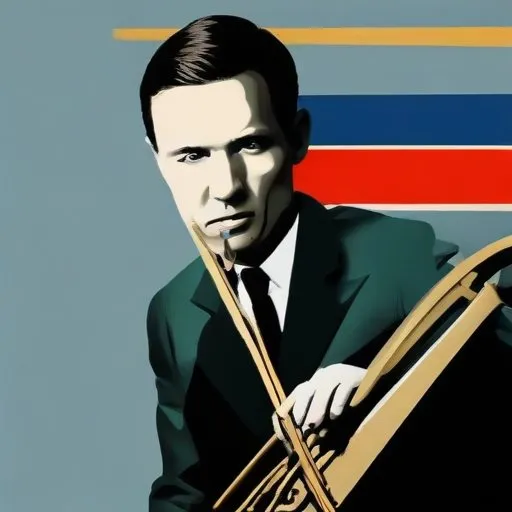
A renowned British trombonist and composer, he was a key figure in the development of British jazz, leading his own bands and creating innovative arrangements. His music blended traditional jazz with modern classical influences.
Known as the leader of Britain's greatest post-war big band, Ted Heath was a British musician and bandleader who left an indelible mark on the music scene. With a career spanning over four decades, Heath's orchestra recorded over 100 albums, selling a staggering 20 million copies, making him one of the most successful bandleaders of his time.
Born George Edward Heath on March 30, 1902, in London, England, Heath's musical journey began at the tender age of six, when he started playing the tenor horn, encouraged by his father, Bert, a trumpeter and leader of the Wandsworth Town Brass Band. Later, Heath switched to trombone, and soon, both father and son were playing together on numerous dance band recordings of the 1920s and 1930s.
Heath's professional career took off in the 1920s, when he joined the Southern Syncopated Orchestra, an American band on tour in Europe. It was during this stint that Heath learned the intricacies of jazz and swing from the band's drummer, Benny Payton. He later played with the MetroGnomes, a small band fronted by Ennis Parkes, and eventually joined Jack Hylton's larger stage band, staying until 1930.
In the 1940s, Heath formed his own orchestra, which would go on to become one of the most successful and longest-running big bands in Britain. The orchestra's unique sound, which blended traditional British music with American swing and jazz, captivated audiences across the country. Heath's band was known for its energetic performances, featuring a range of talented musicians and vocalists, including trumpeter Kenny Baker and singer Lita Roza.
Ted Heath's orchestra remained a cultural phenomenon throughout the 1950s and 1960s, with its music played on radio, television, and live performances. Heath's legacy extends beyond his own musical career, as he helped launch the careers of many British musicians and contributed to the development of British popular music. Even after his death in 1969, the Ted Heath Orchestra continued to perform and record, eventually disbanding in 2000.
Heath was known for his charismatic personality and sense of humor, which endeared him to his fans and fellow musicians. Despite his busy schedule, Heath was devoted to his family, and his wife, Moira, played an important role in managing his career.
In conclusion, Ted Heath was a true legend of British music, whose legacy continues to inspire and influence new generations of musicians and music enthusiasts. His contributions to British popular music are immeasurable, and his orchestra's music remains a testament to the power of big band jazz and swing.
Born in 1911
A pioneering figure in jazz, known for his innovative and eclectic style, blending orchestral and Latin American influences to create a unique sound.
Born in 1913
A legendary jazz musician and bandleader, known for his virtuosic saxophone and clarinet playing, and leading his iconic orchestra through the swing and bebop eras.
Born in 1917
A virtuosic trumpet player and composer who revolutionized jazz with his lightning-fast solos and iconic puffy cheeks, creating a new language for the instrument. He's synonymous with bebop and modern jazz.
Born in 1904
A legendary jazz pianist and bandleader who led a iconic orchestra, blending swing and blues to create a unique sound that influenced generations of musicians. Known for his distinctive "less-is-more" style and hits like "April in Paris" and "One O'Clock Jump".
Born in 1909
A virtuosic clarinetist and bandleader, known as the "King of Swing," who revolutionized jazz music with his energetic and sophisticated style, leading a racially integrated orchestra in the 1930s.
Born in 1910
A virtuosic clarinetist and innovative bandleader, he revolutionized the swing era with his unique sound and iconic hits like "Begin the Beguine" and "Stardust".
Born in 1904
A legendary trombonist, composer, and bandleader who led one of the most popular big bands of the 1930s and 1940s, creating iconic hits like "In the Mood" and "Moonlight Serenade".
Born in 1912
A renowned saxophonist, composer, and bandleader, known for his iconic big band sound and hits like "Sentimental Journey" and "My Heart Belongs to Daddy".
