


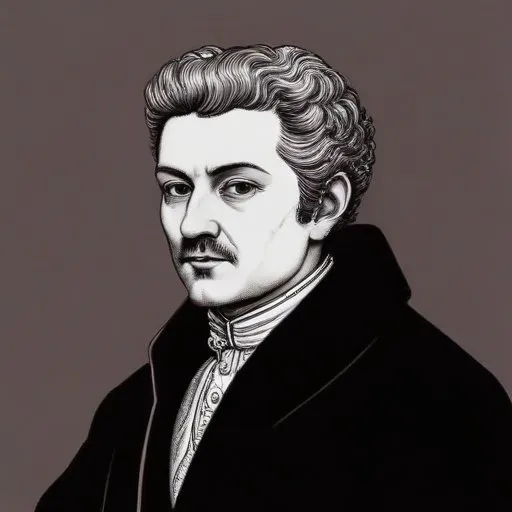
A 17th-century polymath who combined medicine, astrology, and mathematics to understand the universe, creating intricate diagrams and writings that blended science and mysticism.
Robert Fludd, a 17th-century English physician, is renowned for his pioneering work in occult philosophy, astrology, mathematics, cosmology, Qabalah, and Rosicrucianism. His compilations in occult philosophy have left an indelible mark on the intellectual landscape of his time, earning him a place among the most influential thinkers of the Renaissance.
Born on January 17, 1574, at Milgate House, Bearsted, Kent, Fludd was the son of Sir Thomas Fludd, a high-ranking governmental official and Member of Parliament, and Elizabeth Andrews Fludd. His family's coat of arms, showcased in a painting above his right shoulder, dates back to Rhirid Flaidd, a Welsh ancestor whose name translates to "bloody or red wolf."
Fludd entered St John's College, Oxford, in 1591, graduating with a B.A. in 1597 and an M.A. in 1598. During his time at Oxford, he was exposed to the teachings of Matthew Gwinne, a Medical Fellow who practiced Galenic medicine and was familiar with Paracelsian medical works, which likely influenced Fludd's later medical philosophy and practice.
Between 1598 and 1604, Fludd traveled extensively throughout Europe, studying medicine, chemistry, and hermeticism. His itinerary is not well-documented, but he spent a winter in the Pyrenees studying theurgy, the practice of spiritual alchemy.
Fludd's intellectual pursuits were characterized by a synthesis of scientific and hermetic approaches to knowledge. His most notable exchanges were with Johannes Kepler, a renowned astronomer, with whom he debated the merits of scientific and hermetic methods. This exchange reflects Fludd's commitment to exploring the boundaries of human knowledge and understanding.
Robert Fludd's work has left an indelible mark on the development of occult philosophy, inspiring generations of thinkers and scholars. His synthesis of scientific and hermetic approaches has paved the way for interdisciplinary research and inquiry.
As a testament to his enduring influence, Fludd's ideas have been cited by prominent figures such as William Blake, Francis Bacon, and Isaac Newton, solidifying his place as a foundational figure in the history of Western esotericism.
Fludd's work on astrology and cosmology has contributed significantly to our understanding of the celestial sphere and its influence on human affairs. His concepts, such as the macrocosm and microcosm, continue to inspire research in astrology, cosmology, and esotericism.
Through his life and work, Robert Fludd has demonstrated the importance of interdisciplinary inquiry, intellectual curiosity, and the pursuit of knowledge. As a Renaissance man, he has left an enduring legacy, inspiring future generations to explore the mysteries of the universe.
Born in 1564
Renowned playwright and poet behind iconic works like Romeo and Juliet, Hamlet, and Macbeth, whose writings continue to influence literature and theater to this day.
Born in 1561
A 16th-17th century Renaissance figure who pioneered the scientific method and empiricism, and served as a prominent government official.
Born in 1577
A 17th-century polymath who wrote extensively on melancholy, anatomy, and literature, producing influential works that shaped the Renaissance era's understanding of human emotions and the natural world.
73 Years Old
A multi-talented artist known for his eclectic music style, which blends punk, folk, and country elements, and his poetic lyrics that often explore themes of love, death, and social commentary.
Born in 1555
A 16th-century occultist who claimed to communicate with angels and demons, revealing cryptic messages and prophecies that fascinated European nobility and intellectuals.
Born in 1501
This 16th-century Renaissance polymath was a pioneer in probability theory, algebra, and cryptography, leaving an enduring mark on mathematics and science.
Born in 1486
A 16th-century German scholar who delved into the mysteries of the universe, exploring the connections between faith, stars, and ancient wisdom, leaving behind a legacy of esoteric writings.
Born in 1546
A 16th-century astronomer who made precise measurements of the stars and planets, laying the foundation for modern astronomy. His data helped Kepler discover planetary orbits.
