


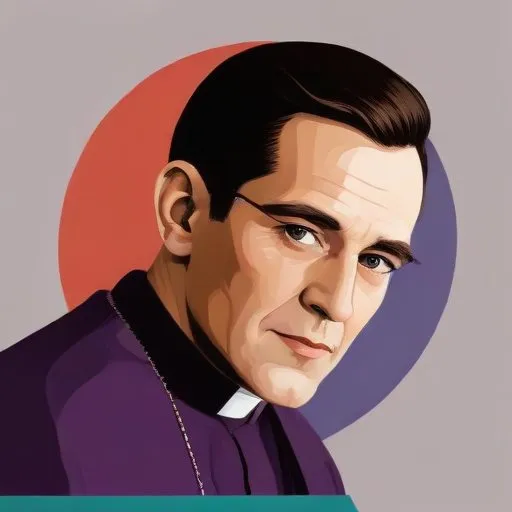
A Catholic priest who wrote influential apocalyptic novels, particularly "Lord of the World", which predicted a dystopian future and remains a classic of the genre.
Robert Hugh Benson, an English Catholic priest, and writer, is best known for his dystopian novel Lord of the World, a prophetic work that predicted a future where humanity is plagued by secularism, materialism, and totalitarianism. His writings spanned multiple genres, including historical, horror, science fiction, contemporary fiction, children's stories, plays, apologetics, and devotional works.
Born on November 18, 1871, Benson was the youngest son of Edward White Benson, the Archbishop of Canterbury, and his wife, Mary. He was educated at Eton College and later studied classics and theology at Trinity College, Cambridge, from 1890 to 1893.
In 1895, Benson was ordained a priest in the Church of England by his father. However, after his father's sudden death in 1896, Benson's own health began to deteriorate, and he embarked on a trip to the Middle East. It was during this trip that he began to question the status of the Church of England and considered the claims of the Catholic Church.
In 1901, Benson joined the Community of the Resurrection, an Anglican community, and made his profession as a member. However, as he continued his studies and writing, he became increasingly uneasy with his own doctrinal position. On September 11, 1903, he was received into the Catholic Church and later ordained as a Catholic priest.
Benson's literary output was prolific, with works that included historical, horror, and science fiction. His notable works include Come Rack! Come Rope!, a historical novel set during the English Reformation, and The Dawn of All, a science fiction novel that explores the possibility of a future where the Catholic Church triumphs over secularism.
Benson's writing career flourished alongside his ecclesiastical career. In 1911, he was appointed as a Chamberlain to Pope Pius X and was later awarded the title of Monsignor. His literary works, especially Lord of the World, gained widespread recognition and acclaim, solidifying his position as a prominent Catholic writer and thinker.
Benson's legacy extends beyond his writings. He played a significant role in shaping the intellectual landscape of the Catholic Church in the early 20th century. His prophetic vision and apologetic writings continue to inspire and influence Catholic thought and literature to this day.
Robert Hugh Benson's life and works continue to inspire and influence generations of Catholics and scholars. His prophetic vision, apologetic writings, and literary contributions have cemented his place as one of the most important Catholic writers of the early 20th century.
Born in 1874
A renowned writer and thinker who crafted clever essays, poems, and plays that explored the human condition, often with a dash of wit and humor. His works continue to inspire and challenge readers to this day.
Born in 1870
A French-born British writer and historian, he's renowned for his witty, humorous, and insightful writings on history, politics, and culture, particularly his Cautionary Tales for Children.
Born in 1903
A renowned English writer, known for his witty satires and novels of manners, particularly "Brideshead Revisited", which explores the British aristocracy's decline.
Born in 1918
A Scottish novelist celebrated for her witty, insightful, and nuanced portrayals of human relationships, morality, and the search for meaning in post-war Britain.
74 Years Old
A Canadian actor who appeared in over 150 films and TV shows, often playing Native American and First Nations characters, and was a pioneer for Indigenous representation in media.
Born in 1892
Creator of Middle-earth, a richly detailed fantasy world, and author of The Hobbit and The Lord of the Rings trilogy, which have become cultural touchstones.
Born in 1898
Renowned author of fantasy series, including The Chronicles of Narnia, and prominent Christian apologist, exploring the intersection of faith and reason.
Born in 1801
A leading figure in the Oxford Movement, he was a prominent theologian and philosopher who converted to Catholicism, influencing Christian thought and education. He's also known for his poetry and hymns.
