


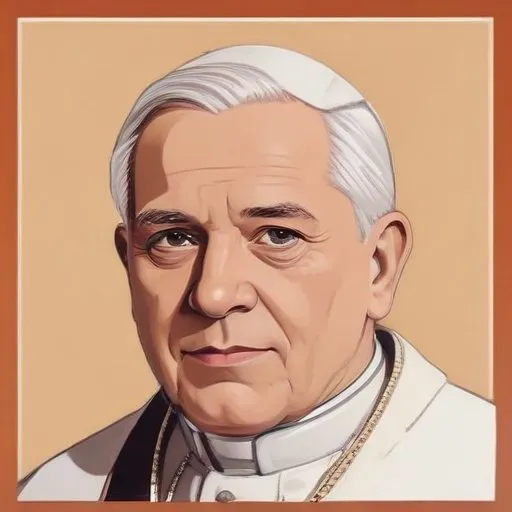
A reform-minded pope who fought against modernist theology and promoted a return to traditional Catholic values, known for his conservative stance and canonization of saints.
Pope Pius X is remembered as a stalwart defender of Catholic orthodoxy and a champion of liturgical reform. Throughout his papacy, he vigorously opposed modernist interpretations of Catholic doctrine, instead promoting scholastic theology and liturgical renewal.
Giuseppe Melchiorre Sarto, later known as Pope Pius X, was born on June 2, 1835, in Riese, Italy. He was raised in a poor but devout family and was drawn to the priesthood from a young age. Sarto was ordained in 1858 and went on to serve as a parish priest, bishop, and eventually, patriarch of Venice.
In 1903, Sarto was elected as the 257th Pope, taking the name Pius X. During his papacy, he initiated a number of reforms aimed at revitalizing the Catholic Church. One of his most notable achievements was the development of the 1917 Code of Canon Law, a comprehensive and systemic work that standardized church law.
Pius X was a strong advocate for the Liturgical Movement, encouraging active participation of the faithful in the Mass. He issued the motu proprio Tra le sollecitudini in 1903, which promoted the frequent reception of Holy Communion and lowered the age for First Communion.
Pius X was a staunch supporter of Thomism, promoting it as the principal philosophical method to be taught in Catholic institutions. He vehemently opposed 19th-century philosophies that he viewed as incompatible with Catholic dogma, particularly modernism, which he saw as a synthesis of every heresy.
Pius X was known for his simple and austere lifestyle, reflecting his commitment to personal poverty. He was a member of the Third Order of Saint Francis and regularly gave sermons from the pulpit, a rare practice at the time.
Following the 1908 Messina earthquake, Pius X opened the Apostolic Palace to refugees, providing aid and shelter before the Italian government acted.
Pius X's papacy had a profound impact on the Catholic Church, shaping its liturgy, doctrine, and practice. He is venerated as a saint in the Catholic Church, and the Society of Saint Pius X, a traditionalist Catholic fraternity, was formed in his honor.
Today, Pius X is remembered as a champion of tradition and liturgical reform, whose commitment to Catholic orthodoxy continues to inspire and guide the faithful.
Pius X's strong stance against modernism and his efforts to reform the Catholic Church were not without controversy. Some critics viewed him as reactionary and inflexible, while others saw him as a beacon of hope and tradition in a rapidly changing world.
Despite the criticisms, Pius X remains an important figure in Catholic history, a testament to the power of faith and conviction in the face of adversity.
Born in 1675
A 18th-century pope who reformed the Catholic Church, promoting tolerance and scholarship, and is known for his encyclicals on topics like usury and the sacraments.
Born in 1881
Reformed the Catholic Church, introducing progressive reforms and ecumenical dialogue, and convened the Second Vatican Council.
Born in 1417
A 15th-century pope who played a significant role in the fall of the Western Schism, ending the division in the Catholic Church. He's also known for his lavish spending and nepotism.
Born in 1810
The first pope to fully embrace modernity, he issued the groundbreaking encyclical Rerum Novarum, which addressed social justice and workers' rights, shaping the Catholic Church's stance on social issues.
Born in 1876
The leader of the Catholic Church from 1939 to 1958, known for his controversial role during World War II, particularly in regards to the Holocaust. He is also remembered for his encyclicals on social justice and liturgical reforms.
Born in 1554
Established the Congregation for the Propagation of the Faith, a missionary organization that aimed to spread Catholicism globally, and standardized the papal conclave process.
Born in 1568
The 17th-century Catholic leader who reigned for 21 years, known for his strong stance against Galileo Galilei and his scientific discoveries, as well as his extensive patronage of the arts.
Born in 1611
Led the Catholic Church during a tumultuous period, reforming the Church's finances and combating corruption, while also opposing the French monarch's attempts to exert control over the Church.
