


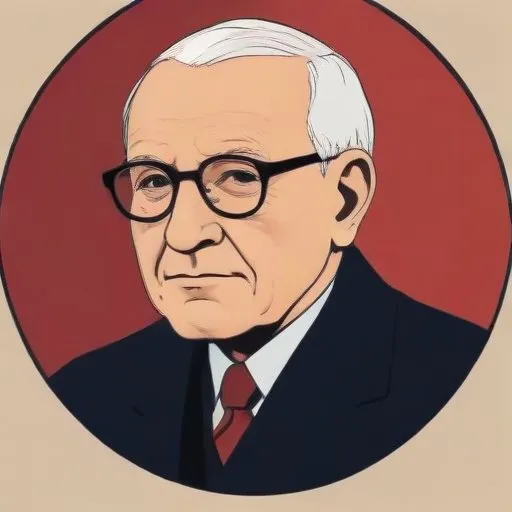
Pioneering sociologist who co-authored the influential "Middletown" studies, providing groundbreaking insights into American middle-class life and culture.
Robert Staughton Lynd is renowned for conducting the first Middletown studies, a groundbreaking sociological project that gave voice to the everyday lives of Americans in the early 20th century. His work, in collaboration with his wife Helen Lynd, produced two seminal books: Middletown: A Study in Contemporary American Culture (1929) and Middletown in Transition: A Study in Cultural Conflicts (1937).
Born on September 26, 1892, in New Albany, Indiana, Lynd graduated from Princeton University with a Bachelor of Arts degree in 1914. He later attended the New School for Social Research (1919-1921, 1933) and the Union Theological Seminary in New York City (1920-1923), where he earned a Bachelor of Divinity degree. Lynd received his Ph.D. in sociology from Columbia University in 1931, using an abridged version of Middletown as his dissertation.
The Middletown studies, conducted in Muncie, Indiana, aimed to capture the essence of American culture by examining the daily lives of ordinary people. Lynd's innovative approach used social surveys to gather data, making him a pioneer in the field. His work humanized statistics, revealing the complexities and contradictions of American society during the interwar period.
Lynd taught sociology at Columbia University from 1931 to 1960, influencing generations of scholars. He served on various U.S. government committees, including President Herbert Hoover's Research Committee on Social Trends and President Franklin D. Roosevelt's Consumers Advisory Board of the National Recovery Administration. Lynd was also a member of several scientific societies, solidifying his reputation as a respected academic and public intellectual.
Lynd married Helen Merrell in 1921, with whom he had two children: Staughton Lynd, a lawyer, historian, and social justice activist, and Andrea Merrell Lynd Nold. Helen Lynd played a crucial role in the Middletown studies, co-authoring both books with her husband. Robert Staughton Lynd passed away on November 1, 1970, leaving behind a rich legacy in the field of sociology.
Lynd's work has had a lasting impact on American sociology, shaping the discipline and inspiring future generations of researchers. His emphasis on social surveys and empirical data collection helped establish sociology as a rigorous scientific field. Lynd's influence extends beyond academia, as his work continues to inform policy, social commentary, and popular culture.
In conclusion, Robert Staughton Lynd's pioneering work in sociology has left an indelible mark on our understanding of American culture and society. His groundbreaking Middletown studies continue to inspire researchers, policymakers, and the general public alike, cementing his legacy as one of the most important sociologists of the 20th century.
Born in 1916
A pioneering sociologist who coined the term "power elite" and wrote influential books on social structure, criticizing the concentration of power and wealth in modern societies.
Born in 1902
Developed the social action theory, which explores how individuals interact with their social environments, and is known for his work on the sociology of medicine and the professions.
Born in 1910
Developed the concept of "self-fulfilling prophecy" and coined terms like "role model" and "unintended consequences," greatly influencing sociology and social psychology.
Born in 1901
Pioneering sociologist who developed innovative research methods and applied them to study mass media's impact on society, particularly in the context of voting behavior and consumerism.
