


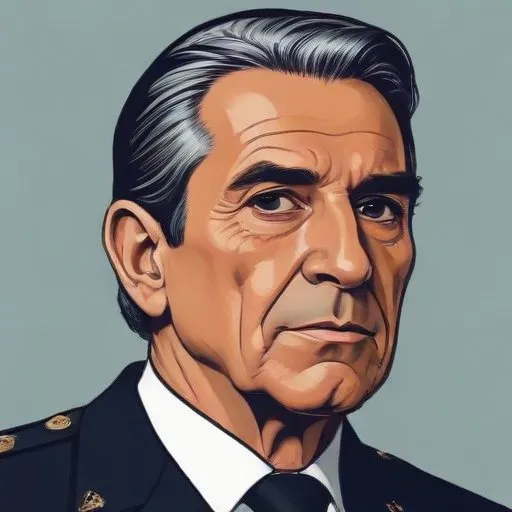
A military leader who briefly ruled Argentina during a tumultuous period, known for his role in the country's transition from dictatorship to democracy.
Roberto Eduardo Viola, born on October 13, 1924, was an Argentine military officer who rose to become the 48th President of Argentina and the 2nd President of the National Reorganization Process. As a military dictator, Viola's presidency was marked by controversy and turmoil.
Viola's journey to the presidency began when he succeeded Jorge Rafael Videla as the head of the Argentine junta. On March 29, 1981, Viola formally assumed the post of President of Argentina, marking the beginning of a tumultuous period in the country's history.
One of Viola's key actions as President was the appointment of Lorenzo Sigaut as finance minister. Sigaut's economic policies, which aimed to reverse the previous administration's decisions, were met with widespread criticism. The abolishment of the sliding exchange rate mechanism and the devaluation of the peso led to a severe recession, destabilizing Viola's position.
Viola's presidency was also marred by infighting within the armed forces. The conflict with Eduardo Massera, the former Navy chief, threatened Viola's authority and led to further instability in the government.
Despite the turmoil at home, Viola's presidency saw an improvement in Argentina-United States relations. The Ronald Reagan administration's shift in policy led to the reestablishment of diplomatic ties and CIA collaboration with the Argentine intelligence service.
Viola's presidency was marked by controversy and human rights abuses. His regime was responsible for numerous atrocities, including the forced disappearance of political opponents and human rights activists. Despite his controversial legacy, Viola remains a significant figure in Argentine history.
Viola was born to Italian immigrant parents, Angelo Viola and Rosa Maria Prevedini, in Casatisma, a town in the Province of Pavia. After his removal from office on December 11, 1981, Viola lived a relatively quiet life until his death on September 30, 1994.
Born in 1925
A ruthless military dictator who ruled Argentina from 1976 to 1981, notorious for human rights abuses and disappearances during the Dirty War.
Born in 1925
An Argentine naval officer who served as a commander of the Navy and a member of the military junta that ruled Argentina from 1976 to 1983, notorious for human rights abuses and forced disappearances.
98 Years Old
The last dictator of Argentina's military junta, known for his brutal regime and human rights abuses during the Dirty War. He was later convicted of crimes against humanity.
Born in 1895
The authoritarian leader who ruled Argentina with his charismatic wife Eva, implementing populist economic policies and promoting nationalism, while suppressing opposition and civil liberties.
Born in 1919
A former actress who used her charisma and influence to advocate for women's suffrage and workers' rights, becoming a beloved and powerful figure in Argentine politics.
99 Years Old
The first democratically elected president of Argentina after a period of military rule, known for his efforts to promote human rights and democracy in the country.
