


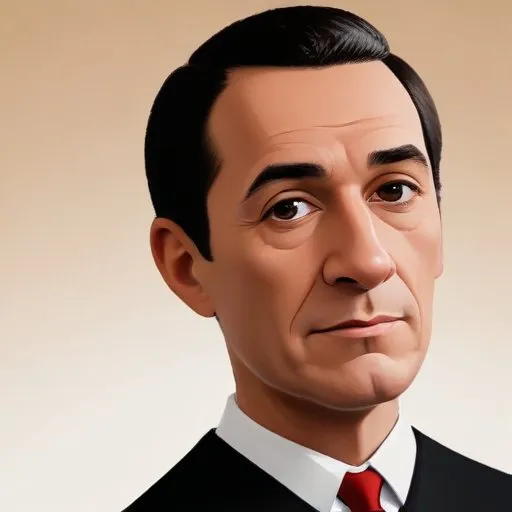
A Spanish judge who presided over the court that issued an international arrest warrant for former Chilean dictator Augusto Pinochet, leading to his detention in the UK. He's known for his role in pursuing accountability for human rights abuses.
Roberto GarcaCalvo Montiel, a Spanish judge, is perhaps best known for his controversial tenure as a member of the Constitutional Court of Spain, where he served from 2001 until his passing in 2008. His appointment, sponsored by the conservative People's Party, sparked debate about the persistence of Francoist ideology in Spanish institutions.
Born in 1942 in La Baeza, Villaviciosa de Odn, Madrid, GarcaCalvo Montiel's early life was marked by his involvement in the Franco regime. During the final year of the Francoist State, he served as a local official, notoriously repressing workers' strikes.
GarcaCalvo Montiel's career trajectory took a significant turn in 2001 when he was appointed to the Constitutional Court of Spain. This move was met with criticism, as many saw it as a perpetuation of the Francoist ideology and a threat to the country's democratic progress.
GarcaCalvo Montiel's legacy is complex and multifaceted. While some saw him as a symbol of the country's struggle to come to terms with its fascist past, others viewed him as a relic of a bygone era, out of touch with modern Spanish society.
Roberto GarcaCalvo Montiel passed away on May 17, 2008, at the age of 65, due to natural causes.
In the years since his passing, Spain has continued to grapple with its complicated history and the ongoing struggle to reconcile its democratic present with its authoritarian past. GarcaCalvo Montiel's legacy serves as a poignant reminder of the importance of critically examining the country's institutions and the individuals who shape them.
Roberto GarcaCalvo Montiel's life and career were marked by controversy and debate. While his legacy remains a topic of discussion, it is undeniable that he played a significant role in shaping the Spanish justice system and the country's ongoing struggle to come to terms with its past.
66 Years Old
The 5th Prime Minister of Spain, serving from 2004 to 2011, known for withdrawing Spanish troops from Iraq and introducing same-sex marriage legislation. He also played a key role in shaping the country's economic and social policies.
71 Years Old
The Prime Minister of Spain from 2011 to 2018, known for his conservative policies and leadership during the European sovereign-debt crisis. He played a key role in shaping Spain's economy and politics during a tumultuous period.
84 Years Old
The Prime Minister of Spain from 1982 to 1996, known for leading the country's transition from dictatorship to democracy and implementing significant economic and social reforms.
73 Years Old
The Prime Minister of Spain from 1996 to 2004, known for leading the country's economic growth and membership in the European Union. He's also remembered for his support of the US-led Iraq War.
84 Years Old
A Spanish physicist-turned-politician who served as Minister of Foreign Affairs, known for his diplomatic efforts in shaping the European Union's foreign policy. He played a key role in international crisis management and conflict resolution.
54 Years Old
The current Prime Minister of Spain, leading the country's government and implementing policies to address economic and social issues. Known for his progressive stance on issues like climate change and social justice.
