


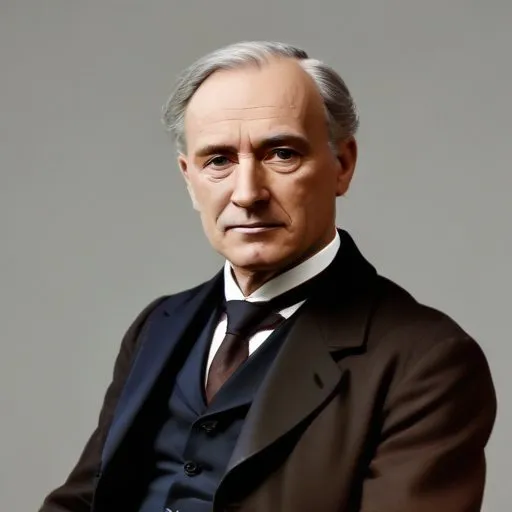
A French novelist and paleographer who won the Nobel Prize in Literature in 1937 for his novel "Les Thibault", a sprawling family saga that explores the decline of the French aristocracy. He's known for his meticulous historical research and detailed character portrayals.
Roger Martin du Gard, a French novelist, stands tall among the literary giants of the 20th century, renowned for his monumental work, Les Thibaults, a sweeping narrative that spans generations and continents. This extraordinary novel earned him the prestigious Nobel Prize in Literature in 1937.
Born on March 23, 1881, in Neuilly-sur-Seine, France, Martin du Gard was trained as a paleographer and archivist, a background that instilled in him a meticulous attention to detail and a passion for historical accuracy. This unique blend of skills would later shape his literary style, enriching his fiction with a depth of context and a commitment to documentation.
Les Thibaults, a roman fleuve, or novel cycle, is Martin du Gard's magnum opus. The work follows the fortunes of two brothers, Antoine and Jacques Thibault, from their comfortable upbringing in a prosperous Catholic bourgeois family to the outbreak of World War I. Written between 1922 and 1940, the novel consists of eight volumes, with the last two parts published in 1936 and 1940, respectively.
Set against the backdrop of a tumultuous Europe in the early 20th century, Les Thibaults is a sprawling epic that explores themes of family, history, politics, and human development. The novel's scope and ambition are breathtaking, with Martin du Gard's masterful storytelling weaving together the intimate and the epic, the personal and the historical.
Martin du Gard's work is often linked to the realist and naturalist traditions of the 19th century, and his fiction reveals a deep empathy with the humanist socialism and pacifism of Jean Jaurès. His writing is characterized by a commitment to objectivity, a rigorous attention to detail, and a profound concern for the human condition.
Beyond Les Thibaults, Martin du Gard wrote several other notable novels, including Jean Barois, set against the Dreyfus Affair, and Confidence africaine, a work that explores the complexities of colonialism. He also penned plays and a memoir of his friend, André Gide.
Martin du Gard's literary legacy is profound and far-reaching. His work has been translated into numerous languages, and his influence can be seen in the writing of many prominent authors. He remains one of the most important and respected French novelists of the 20th century, and his Nobel Prize in Literature is a testament to his enduring contributions to world literature.
During World War II, Martin du Gard lived in Nice, where he worked on an unfinished novel, Souvenirs du lieutenant-colonel de Maumort, which was published posthumously in 1983. He passed away on August 22, 1958, and was buried in the Cimiez Monastery Cemetery in Nice, France.
Born in 1871
A French literary mastermind who penned the monumental, introspective novel "In Search of Lost Time", exploring the human experience through vivid, nostalgic storytelling.
Born in 1869
A French literary giant, renowned for his novels and essays that explored the human condition, morality, and the search for authenticity. His works often blurred the lines between fiction and autobiography.
Born in 1905
Existentialist philosopher and playwright who argued that humans have complete freedom to choose their actions and create their own meaning in life, influencing modern thought on morality and individual responsibility.
Born in 1913
A French novelist, philosopher, and journalist who wrote influential works like "The Stranger" and "The Plague", exploring absurdism and the human condition.
Born in 1885
A French literary giant, celebrated for his novels and plays that probed the human condition, morality, and the complexities of faith. His works are known for their psychological depth and lyrical prose.
Born in 1859
A French philosopher and Nobel laureate who developed the concept of "duration" and emphasized the importance of intuition and experience in understanding reality. He's known for his philosophical ideas on time, consciousness, and the human experience.
Born in 1866
A French historian, author, and playwright who won the Nobel Prize in Literature in 1915 for his contributions to the ideal of international brotherhood and peace. He's best known for his novel "Jean-Christophe", a 10-volume epic that explores the life of a fictional German musician.
Born in 1844
A French writer and poet who won the Nobel Prize in Literature in 1921, known for his witty and satirical novels that critiqued French society.
