


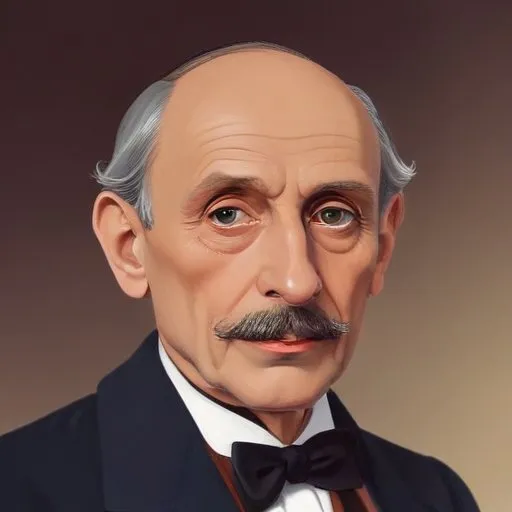
A French historian, author, and playwright who won the Nobel Prize in Literature in 1915 for his contributions to the ideal of international brotherhood and peace. He's best known for his novel "Jean-Christophe", a 10-volume epic that explores the life of a fictional German musician.
Romain Rolland, a French dramatist, novelist, essayist, art historian, and mystic, is best known for his literary works that earned him the prestigious Nobel Prize for Literature in 1915. His writing is characterized by its lofty idealism, sympathy, and love of truth, making him a standout figure in the literary world.
Born on January 29, 1866, in Clamecy, Nièvre, Rolland came from a family with a mix of wealthy townspeople and farmers. He was accepted to the École Normale Supérieure in 1886, where he initially studied philosophy but later abandoned it to avoid conforming to the dominant ideology. Rolland received his degree in history in 1889 and spent two years in Rome, where he met Malwida von Meysenbug, a friend of Nietzsche and Wagner, and discovered Italian masterpieces that greatly influenced his thought.
Rolland's academic career spanned over two decades, during which he taught at various lyces in Paris and directed the music school of the École des Hautes Études Sociales from 1902 to 1911. In 1903, he was appointed to the first chair of music history at the Sorbonne and briefly directed the musical section at the French Institute in Florence in 1911.
His writing career began in 1902, at the age of 36, with the publication of his first book. Rolland's advocacy for a people's theatre and his literary works, including Colas Breugnon (1919), showcased his unique style and thought-provoking ideas.
Rolland was a leading supporter of Joseph Stalin in France and maintained a notable correspondence with Sigmund Freud, a prominent psychologist. Their exchange of letters provides valuable insights into the thought processes and ideologies of these two influential figures.
In 1915, Rolland was awarded the Nobel Prize for Literature, a testament to his literary contributions and commitment to truth and idealism. This prestigious award solidified his position as a prominent figure in the literary world.
Rolland's personal life was marked by his introspective nature, as evident in his writing, particularly in Voyage intérieur (1942). He saw himself as a representative of an antique species, drawing inspiration from his ancestors and the world around him.
Romain Rolland's contributions to literature, art, and history have left a lasting impact on modern society. His commitment to truth, idealism, and the celebration of human diversity continue to inspire generations of writers, artists, and thinkers.
Romain Rolland's legacy is a testament to the power of literature and the human spirit. His writing continues to inspire, educate, and provoke thought, ensuring his place as one of the most influential figures of the 20th century.
Born in 1712
A pioneering thinker who shaped modern democracy and education with his ideas on social contracts, general will, and the importance of early childhood education. His writings influenced the French Revolution and modern political thought.
Born in 1694
A witty and insightful 18th-century writer and philosopher who used satire to critique societal norms and advocate for reason, tolerance, and human rights.
Born in 1821
A pioneering realist novelist who crafted meticulous, psychologically nuanced portrayals of 19th-century French life, particularly in his iconic novel "Madame Bovary".
Born in 1840
A pioneering figure in naturalist literature, known for his influential novels that exposed social ills and championed reform, such as "Germinal" and "Nana".
Born in 1844
A French writer and poet who won the Nobel Prize in Literature in 1921, known for his witty and satirical novels that critiqued French society.
Born in 1859
A French philosopher and Nobel laureate who developed the concept of "duration" and emphasized the importance of intuition and experience in understanding reality. He's known for his philosophical ideas on time, consciousness, and the human experience.
Born in 1869
A French literary giant, renowned for his novels and essays that explored the human condition, morality, and the search for authenticity. His works often blurred the lines between fiction and autobiography.
