


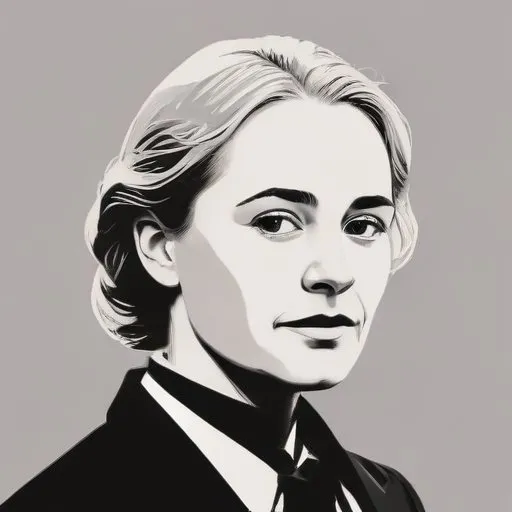
A German writer and memoirist who chronicled her life among European intellectuals and artists, offering a unique perspective on 19th-century cultural and feminist movements.
Malwida von Meysenbug was a German writer, best known for her memoirs, particularly "Memoirs of an Idealist", which she published anonymously in 1869. This trailblazing work not only showcased her remarkable writing skills but also provided a candid account of her unconventional life, marked by unwavering idealism and a quest for social change.
Born on October 28, 1816, in Kassel, Hesse, Malwida was the ninth of ten children to Carl Rivalier, a French Huguenot descendant who received the title of Baron of Meysenbug from William I of Hesse-Kassel. Despite her wealthy upbringing, Malwida refused to conform to her family's expectations, instead choosing to pursue a path that aligned with her strong political convictions.
In 1852, von Meysenbug immigrated to England, where she joined a community of political refugees and began teaching and translating works to support herself. It was during this period that she met prominent figures such as Ledru-Rollin, Louis Blanc, and Gottfried Kinkel, all of whom shared her passion for social reform.
In 1862, von Meysenbug traveled to Italy with Olga Herzen, the daughter of Alexander Herzen, a prominent Russian socialist. During her time in Italy, she introduced Friedrich Nietzsche to several of his friends, including Helene von Druskowitz, and invited Paul Re and Nietzsche to Sorrento in 1876. This fateful meeting would have a profound impact on Nietzsche's work, as he began writing "Human, All Too Human" during his stay.
Von Meysenbug's "Memoirs of an Idealist" was widely acclaimed, and its success can be measured by the fact that it was re-read by George Gissing, a prominent English novelist, in 1890. In 1901, von Meysenbug became the first woman to be nominated for the Nobel Prize in Literature, a testament to her groundbreaking contributions to literature.
Malwida von Meysenbug's remarkable life and work have inspired countless individuals, including notable figures such as Richard Wagner and Romain Rolland. Her unwavering commitment to her ideals, coupled with her literary prowess, has cemented her place as a pioneering figure in the world of literature.
Malwida von Meysenbug's remarkable story serves as a testament to the power of conviction, perseverance, and literary talent. Her pioneering spirit continues to inspire generations, ensuring her place as a trailblazing figure in the world of literature.
Born in 1803
A leading figure in the Transcendentalist movement, he advocated for individualism, self-reliance, and nature-inspired spirituality through his essays and poetry. His ideas continue to influence American thought and culture.
Born in 1817
A 19th-century thinker who advocated for simple living, civil disobedience, and individualism, inspiring generations to reevaluate their relationship with nature and society.
Born in 1813
A revolutionary composer who transformed opera with his epic, mythological works, creating a new era of musical storytelling. His iconic operas, such as "Der Ring des Nibelungen," continue to captivate audiences worldwide.
Born in 1811
A virtuosic pianist and composer who revolutionized classical music with his technically demanding and emotionally expressive works, blending Hungarian folk influences with Romantic-era drama.
Born in 1833
A renowned pianist and composer, he crafted complex, expressive works that blended traditional and innovative techniques, leaving an indelible mark on classical music.
Born in 1819
A renowned 19th-century pianist and composer, she was one of the first females to achieve recognition in a male-dominated field, creating over 60 pieces of music. Her compositions showcased romanticism and lyricism.
Born in 1810
A renowned Romantic-era composer and influential music critic, known for his expressive and emotionally charged works, including symphonies, piano music, and art songs.
