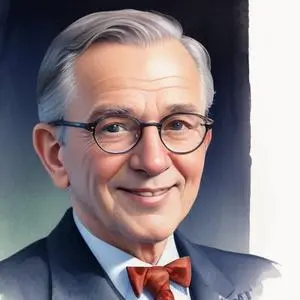
Roger Wolcott Sperry: The Pioneer of Split-Brain Research
A Nobel Laureate and a Champion of Interdisciplinary Research
Roger Wolcott Sperry, a renowned American neuropsychologist, neurobiologist, and cognitive neuroscientist, is best known for his groundbreaking work on split-brain research, which earned him the 1981 Nobel Prize in Physiology and Medicine, alongside David Hunter Hubel and Torsten Nils Wiesel. His pioneering work revolutionized the understanding of brain function, localization, and the interconnectedness of the two cerebral hemispheres.
Early Life and Education
Born on August 20, 1913, in Hartford, Connecticut, to Francis Bushnell and Florence Kraemer Sperry, Roger grew up in an upper-middle-class environment that emphasized academic achievement. His father's sudden passing at the age of 11 forced his mother to take on the role of assistant principal at the local high school, where she instilled in Roger a strong sense of determination and resilience.
Roger excelled in sports and academics at Hall High School, earning a scholarship to Oberlin College. At Oberlin, he captained the basketball team, participated in various sports, and worked at a campus cafe to support himself. Initially an English major, Roger's fascination with psychology blossomed after taking an introductory course taught by Professor R. H. Stetson, who had worked with
William James, the father of American Psychology. Roger's interactions with Stetson and his colleagues sparked a deep interest in the brain's workings, leading him to pursue a master's degree in psychology from Oberlin.
The Split-Brain Research and Nobel Prize
Sperry's most significant contribution to science lies in his split-brain research, which demonstrated that the two cerebral hemispheres are functionally independent yet interconnected. His work involved surgically separating the corpus callosum, the bundle of nerve fibers connecting the two hemispheres, to study the resulting effects on behavior and cognition. These experiments led to a fundamentally new understanding of brain function, challenging the previously held views on localization and lateralization.
The significance of Sperry's work was recognized globally, culminating in the 1981 Nobel Prize in Physiology and Medicine, shared with David Hunter Hubel and Torsten Nils Wiesen. This accolade solidified Sperry's position as a leader in the field of neuropsychology and cognitive neuroscience.
Legacy and Impact
Roger Wolcott Sperry's work has had a profound impact on various fields, including psychology, neuroscience, neurobiology, and cognitive science. His research has:
- Influenced the development of neuroscientific theories, such as the concept of lateralization and the functional asymmetry of the brain.
- Led to a better understanding of brain function, particularly in relation to language, cognition, and behavior.
- Opened up new avenues for research in fields like neurology, neurosurgery, and psychology.
Sperry's influence extends beyond the scientific community, as his work has paved the way for improved diagnosis and treatment of various neurologically-based disorders, such as epilepsy, brain tumors, and stroke.
Awards and Honors
Sperry's numerous awards and honors include:
- 1981 Nobel Prize in Physiology and Medicine
- APA Distinguished Scientific Contribution Award (1971)
- National Medal of Science (1976)
- Albert Lasker Award (1979)
Personal Milestones and Key Life Events
Roger Sperry's life was marked by:
- Marriage to Norma Deupree in 1942
- Two children, Nancy and Richard
- A successful athletic career, including being an NBA referee
- A passion for sailing and the outdoors
Sperry's remarkable journey serves as an inspiration to aspiring scientists, demonstrating the power of interdisciplinary research, determination, and a relentless pursuit of knowledge.
Conclusion
Roger Wolcott Sperry's pioneering work on split-brain research has left an indelible mark on the scientific community. His legacy continues to shape our understanding of brain function, cognition, and behavior, cementing his place as one of the most influential scientists of the 20th century.
FAQ
What was Roger Wolcott Sperrys contribution to neuroscience?
Roger Wolcott Sperrys contribution to neuroscience was significant, as he discovered the role of the corpus callosum in integrating information between the two hemispheres of the brain.
What was Roger Wolcott Sperrys Nobel Prize-winning research on?
Roger Wolcott Sperrys Nobel Prize-winning research was on the functional specialization of the brain, specifically the role of the corpus callosum in brain function.
What was Roger Wolcott Sperrys work on split-brain research?
Roger Wolcott Sperrys work on split-brain research involved studying the behavior of patients who had undergone surgical separation of the two hemispheres of the brain, revealing insights into brain function and behavior.
What was Roger Wolcott Sperrys view on the mind-body problem?
Roger Wolcott Sperrys view on the mind-body problem was that the mind and brain are interconnected, and that consciousness arises from the integration of brain function.
What honors did Roger Wolcott Sperry receive for his work?
Roger Wolcott Sperry received numerous honors for his work, including the Nobel Prize in Physiology or Medicine in 1981 and the National Medal of Science in 1989.