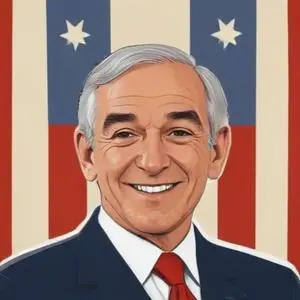
Ron Paul: The Unwavering Champion of Liberty and Limited Government
A Life of Service and Principles
Ron Paul is a name synonymous with unwavering dedication to the principles of liberty, limited government, and constitutionalism. As a three-time Presidential candidate, twelve-term Congressman, and legendary champion of individual freedom, Paul has left an indelible mark on American politics.
A Brief Biography
Born on August 20, 1935, in Pittsburgh, Pennsylvania, Ron Paul grew up in a family of strong moral values and a deep appreciation for education. He earned his medical degree from Duke University and served as a flight surgeon in the U.S. Air Force from 1963 to 1968. After his military service, Paul settled in Texas, where he built a successful medical practice and eventually entered politics.
Career Highlights and Major Works
- Paul served as the U.S. Representative for Texas's 22nd congressional district from 1976 to 1977 and again from 1979 to 1985, as well as for Texas's 14th congressional district from 1997 to 2013.
- In 1988, he ran for President as the Libertarian Party nominee, followed by Republican presidential bids in 2008 and 2012.
- Paul founded the Foundation for Rational Economics and Education (FREE) in 1976 and served as the first chairman of the conservative PAC Citizens for a Sound Economy.
- He has published several books, including "The Case for Gold" and "Liberty Defined," promoting the ideas of Austrian School economists like Murray Rothbard, Friedrich Hayek, and Ludwig von Mises.
Philosophical Contributions and Beliefs
Ron Paul is a self-described constitutionalist, fiercely dedicated to the principles of individual liberty, limited government, and the Constitution. He has been a vocal critic of government overreach, taxation, and military interventionism. Paul believes in:
- Reducing the national debt and abolishing the Federal Reserve
- Protecting individual rights and civil liberties
- Limiting government spending and cutting taxes
- Opposing the war on drugs and the war on terror
- Supporting a non-interventionist foreign policy
Influence on Modern Society
Ron Paul's impact on modern society is undeniable. He has:
- Inspired a generation of libertarians and constitutionalists
- Played a key role in shaping the Tea Party movement
- Influenced a range of politicians, including his son, Senator Rand Paul
- Been a vocal critic of mass surveillance and government overreach
Personal Milestones and Key Life Events
- Became the first Representative in history to serve concurrently with a child in the Senate (Rand Paul) in 2011
- Served as a Senior Fellow and Distinguished Counselor of the Mises Institute
- Was named the "Intellectual Godfather of the Tea Party movement"
Quotes and Memorable Sayings
- "Liberty is not a means to a higher political end. It is itself the highest political end."
- "The system is rigged, and the people are starting to figure it out."
- "You can't have a million-dollar deficit and a million-dollar economy."
Controversies and Public Perception
Throughout his career, Ron Paul has faced criticism and controversy, particularly surrounding his views on foreign policy and race relations. However, he remains a beloved figure among many Americans who admire his unwavering commitment to principle and his unrelenting passion for individual freedom.
Legacy and Impact
Ron Paul's legacy extends far beyond his political accomplishments. He has left an indelible mark on American politics, inspiring a new generation of liberty-minded individuals to take up the torch of freedom. As a champion of the Constitution and individual rights, Paul's impact will be felt for generations to come.
FAQ
What is Ron Pauls background in politics?
Ron Paul is an American politician who served as a member of the U.S. House of Representatives from Texass 14th congressional district. He is known for his libertarian views and his advocacy for limited government.
What is Ron Pauls stance on foreign policy?
Ron Paul is a strong critic of U.S. foreign policy, particularly with regards to military intervention. He has advocated for a non-interventionist approach and has been a vocal opponent of the Iraq War and other military conflicts.
What is Ron Pauls views on economics?
Ron Paul is a strong advocate for limited government and free market economics. He has been critical of the Federal Reserve and has advocated for a return to the gold standard.
Has Ron Paul ever run for president?
Yes, Ron Paul has run for president three times, in 1988, 2008, and 2012. Although he did not win the Republican nomination, his campaigns helped to raise awareness about libertarian issues and ideas.
What is Ron Pauls legacy in politics?
Ron Pauls legacy in politics is as a champion of limited government and individual liberty. He has inspired a new generation of libertarians and has helped to shift the conversation in American politics towards more libertarian ideals.