


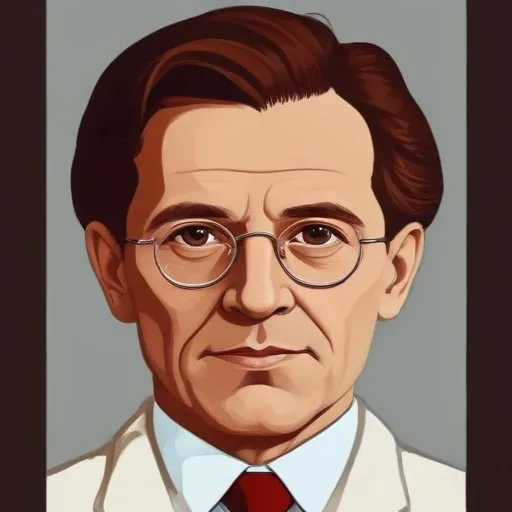
A pioneer in ultracold atomic physics, he created the first Bose-Einstein condensate of fermionic atoms, a groundbreaking achievement in quantum physics. His work has far-reaching implications for quantum computing and simulation.
Rudolf Grimm, an Austrian experimental physicist, is renowned for being the first scientist worldwide to realize a Bose-Einstein condensation of non-polar molecules. His groundbreaking work has revolutionized the field of ultracold atoms and quantum gases, opening doors to new possibilities in quantum physics.
Born on November 10, 1961, Grimm graduated in physics from the University of Hannover in 1986. He then pursued postgraduate research at the ETH Zurich Swiss Federal Institute of Technology from 1986 to 1989, followed by a stint at the Institute of Spectroscopy of the USSR Academy of Sciences in Troitsk near Moscow.
Grimm's research career spans over three decades, with notable positions at the Max Planck Institute for Nuclear Physics in Heidelberg and the University of Innsbruck, where he has been a professor of experimental physics since 2000. He has also held the position of Scientific Director at the Institute for Quantum Optics and Quantum Information (IQOQI) of the Austrian Academy of Sciences since 2003.
Grimm's work has had a profound impact on our understanding of quantum physics, with his discoveries paving the way for further research in the field. His contributions have led to advancements in fields such as superfluidity, which has potential applications in quantum computing and materials science.
Rudolf Grimm is married and has three children. Despite his many accomplishments, he remains committed to his research and continues to inspire new generations of physicists.
Grimm's work embodies the spirit of scientific inquiry, highlighting the importance of fundamental research in advancing our understanding of the natural world. His dedication to his craft serves as a beacon of inspiration, encouraging others to pursue careers in science and research.
69 Years Old
A German physicist and academic who won the Nobel Prize for his groundbreaking work on ultracold atoms and Bose-Einstein condensates, revolutionizing our understanding of quantum mechanics.
64 Years Old
A Nobel Prize-winning physicist who pioneered the creation of ultra-cold atoms, leading to breakthroughs in quantum computing and precision measurement. His work has far-reaching implications for fields like chemistry and materials science.
75 Years Old
A Nobel Prize-winning physicist who advanced our understanding of quantum mechanics and pioneered innovative teaching methods to improve science education. His work has transformed the way we learn and understand physics.
93 Years Old
A Nobel Prize-winning physicist who pioneered the study of laser cooling and trapping, leading to breakthroughs in atomic physics and quantum mechanics.
