


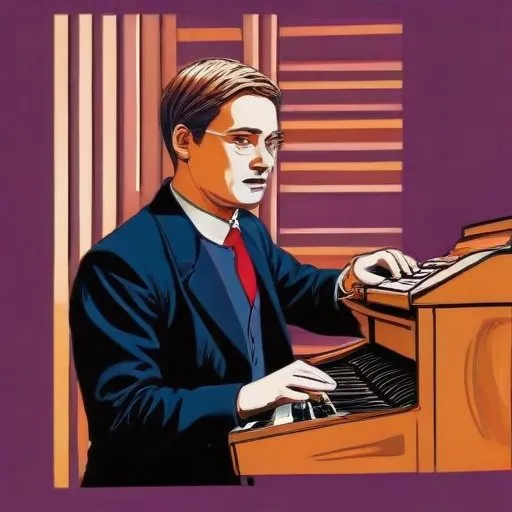
A prolific composer of symphonies, choral works, and organ music, known for his unique blend of Romantic and Modernist styles. His music was largely forgotten until a revival in the 1990s.
Rued Langgaard, a late-Romantic Danish composer and organist, was known for his unconventional music that defied the norms of his time. His music, which was often at odds with that of his Danish contemporaries, was only recognized 16 years after his death, leaving a lasting legacy in the world of classical music.
Born on July 28, 1893, in Copenhagen, Denmark, Rued Langgaard was the only son of composer and Royal Chamber musician Siegfried Langgaard and Emma Langgaard (née Foss), both of whom were pianists. Langgaard's talent for music emerged at a young age, and he began taking piano lessons with his mother at the age of five.
Langgaard's early education was marked by private lessons with some of the most prominent musicians of his time. He studied the organ under Gustav Helsted, organist at the Jesuskirken in Valby, and the violin under Chr. Petersen, formerly of the Royal Orchestra. He also studied music theory under C. F. E. Horneman and Vilhelm Rosenberg.
Langgaard's first compositions, two piano pieces and two songs, were published when he was just 13 years old. Around the same time, he was taught counterpoint by the celebrated composer Carl Nielsen for about a month. A year later, his choral work Musae triumphantes was performed at a concert in Copenhagen, marking his public debut as a composer.
At the age of 11, Langgaard made his first public appearance as an organist and improviser on the organ at a concert at the Frederikskirken Marmorkirken in Copenhagen. He continued to compose and perform throughout his teenage years, even traveling with his parents around Christmas and New Year's Eve, meeting conductors Arthur Nikisch and Max Fiedler.
Langgaard's Symphony No. 1, Mountain Pastorals, received its first performance at a concert in Berlin with the Berlin Philharmonic under the baton of Max Fiedler in 1913. This was followed by a series of compositions that showcased his unique style, including his Symphony No. 2, Vaarbrud, and his opera, Antichrist.
Langgaard's music was often criticized for being too unconventional and avant-garde, which led to a decline in his popularity during his lifetime. However, in the 1960s, his music experienced a resurgence, and he is now recognized as one of the most important Danish composers of the 20th century.
Langgaard served as assistant organist at the Frederikskirken Marmorkirken in Copenhagen from 1913 to 1914. He passed away on July 10, 1952, at the age of 58, leaving behind a legacy of innovative and unconventional music that continues to inspire and influence composers to this day.
In 1953, the Rued Langgaard Society was established to promote his music and legacy. Today, his music is celebrated and performed around the world, and he is recognized as one of the most important Danish composers of the 20th century.
"Music is the only language that can express the inexpressible." - Rued Langgaard
"I do not compose music, I am the vessel through which music flows." - Rued Langgaard
Langgaard's music has had a profound influence on modern classical music, inspiring composers such as Per Nørgård and Ib Nørholm. His unconventional style and approach to composition have made him a pioneer in the world of classical music.
Langgaard's legacy extends beyond music, inspiring artists and writers with his innovative and avant-garde approach to art. He is a testament to the power of creative vision and the importance of staying true to oneself, even in the face of criticism and adversity.
Langgaard was awarded the Anckerske Legat in 1924 and the Det anckerske Legat in 1932.
In 1952, the Rued Langgaard Foundation was established to promote his music and legacy.
Born in 1865
A renowned Danish musician who excelled as a violinist, composer, and conductor, creating iconic works that blended Romantic and Modernist styles. His symphonies and concertos are still widely performed today.
98 Years Old
A right-arm medium-pace bowler and lower-order batsman who played 14 Tests for South Africa from 1955 to 1962, taking 58 wickets at an average of 25.75.
Born in 1811
A virtuosic pianist and composer who revolutionized classical music with his technically demanding and emotionally expressive works, blending Hungarian folk influences with Romantic-era drama.
Born in 1813
A revolutionary composer who transformed opera with his epic, mythological works, creating a new era of musical storytelling. His iconic operas, such as "Der Ring des Nibelungen," continue to captivate audiences worldwide.
Born in 1860
A visionary composer and conductor who expanded symphonic music's emotional depth and complexity, creating works of profound beauty and intensity.
Born in 1843
A renowned pianist and composer, famous for his iconic and romanticized musical interpretations of Norwegian folk culture, particularly his famous piano concerto.
