


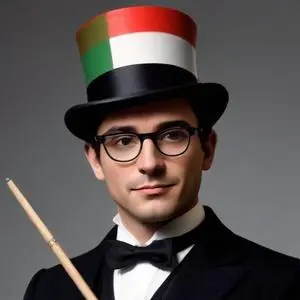
Creator of the iconic opera "Pagliacci," known for its famous aria "Vesti la giubba," which has become a cultural touchstone. This opera's themes of love, betrayal, and tragedy continue to resonate with audiences today.
When the world of opera thinks of Ruggero Leoncavallo, one name immediately comes to mind: Pagliacci. This iconic opera, first performed in 1892, remains the composer's lasting contribution to the world of music. But there's more to Leoncavallo than just this masterpiece.
Born on April 23, 1857, in Naples, Kingdom of the Two Sicilies, Leoncavallo was the son of Vincenzo Leoncavallo, a police magistrate and judge. His family moved to Montalto Uffugo in Calabria during his adolescence, where he spent his formative years.
In 1868, Leoncavallo returned to Naples, enrolling in the San Pietro a Majella Conservatory. This marked the beginning of his musical journey, during which he studied literature under the renowned Italian poet Giosuè Carducci at the University of Bologna from 1876 to 1877.
In 1879, Leoncavallo's uncle Giuseppe, director of the press department at the Foreign Ministry in Egypt, invited his nephew to showcase his pianistic abilities in Cairo. This opportunity led to Leoncavallo securing work as a piano teacher and pianist to the brother of the new Khedive Tewfik Pasha. However, his Egyptian adventure came to an abrupt end in 1882 following revolts in Alexandria and Cairo, led by Urabi.
Leoncavallo fled to France, settling in the artistic hub of Montmartre, Paris. Here, he found work as an accompanist and instructor for artists performing in Sunday concerts at cafés. It was during this period that he met Berthe Rambaud, with whom he would form a lasting relationship.
Leoncavallo's most famous opera, Pagliacci, premiered in 1892 and remains one of the most popular and frequently performed works in the opera repertoire. In addition to Pagliacci, he composed numerous operas and songs, including the beloved song Mattinata, made famous by Enrico Caruso, and the symphonic poem La Nuit de mai.
Pagliacci's success can be attributed, in part, to its exploration of the human condition, delving into themes of love, jealousy, and the blurred lines between reality and performance. This opera has not only had a lasting impact on the world of opera but also on popular culture, influencing countless adaptations and references in film, literature, and music.
Leoncavallo's music often reflected his fascination with the human psyche and the complexities of relationships. Through his work, he sought to explore the intricacies of the human experience, drawing inspiration from the world around him.
Ruggero Leoncavallo's life was a tapestry of experiences, influences, and creative expressions. While Pagliacci remains his most enduring work, his contributions to opera and music extend far beyond this single masterpiece.
Born in 1792
Operatic mastermind behind iconic comedies like "The Barber of Seville" and "William Tell," crafting catchy, witty, and playful music that still delights audiences today.
Born in 1797
A renowned Italian composer of the Romantic era, best known for his operas, particularly "L'elisir d'amore" and "Don Pasquale", which are still widely performed today.
Born in 1801
Operatic mastermind behind bel canto classics like "Norma" and "La Sonnambula", renowned for their beautiful, expressive melodies and dramatic flair.
Born in 1813
A revolutionary composer who transformed opera with his epic, mythological works, creating a new era of musical storytelling. His iconic operas, such as "Der Ring des Nibelungen," continue to captivate audiences worldwide.
Born in 1813
A renowned composer of iconic operas like La Traviata and Aida, known for his masterful blending of drama and music. His works continue to captivate audiences worldwide.
Born in 1811
A virtuosic pianist and composer who revolutionized classical music with his technically demanding and emotionally expressive works, blending Hungarian folk influences with Romantic-era drama.
Born in 1840
A renowned Russian composer and educator, he is best known for his iconic and beloved ballets, such as Swan Lake and The Nutcracker, which continue to enchant audiences worldwide.
