


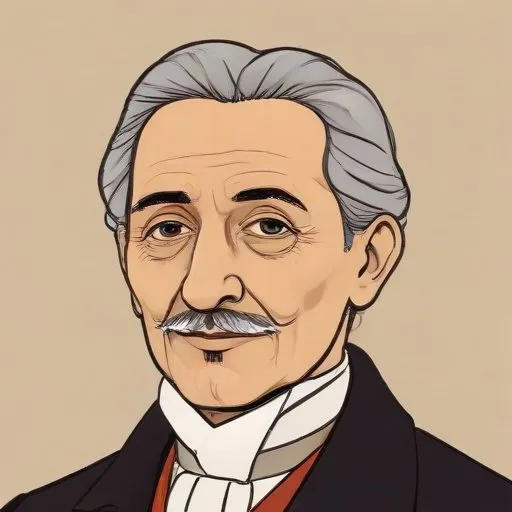
A renowned Italian poet and educator, known for his patriotic and lyrical works that explored themes of Italian identity and unity. He was the first Italian to receive the Nobel Prize in Literature.
Giosu Carducci, an Italian poet, writer, literary critic, and teacher, is widely regarded as the official national poet of modern Italy. He made history in 1906 by becoming the first Italian to receive the Nobel Prize in Literature, a testament to his profound impact on the literary world.
Born on July 27, 1835, in Valdicastello, a small town in the Province of Lucca, Tuscany, Carducci grew up in a family that valued education and literature. His father, a doctor and advocate of Italian unification, was involved with the Carbonari, leading to the family's frequent relocations during Carducci's childhood. This nomadic lifestyle, however, only fueled his passion for learning, particularly Greek and Roman Antiquity.
Carducci's fascination with classical literature led him to translate Book 9 of Homer's Iliad into Italian. He went on to publish his first collection of poems, Rime, in 1857, after graduating from the Scuola Normale Superiore di Pisa. Although these were challenging years, marked by the loss of his father and brother, Carducci's literary pursuits remained unwavering.
In 1859, Carducci married Elvira Menicucci, and they had four children together. He briefly taught Greek at a high school in Pistoia before being appointed Professor of Italian Literature at the University of Bologna. It was during this time that he mentored a young Giovanni Pascoli, who would later become a renowned poet and succeed Carducci at the university.
Carducci's teaching style was characterized by his passion for literature and his ability to inspire future generations of writers. His lectures were highly acclaimed, and he became a fierce critic of literature, always striving for excellence in his own work and that of others.
The Swedish Academy awarded Carducci the Nobel Prize in Literature in 1906, citing his "deep learning and critical research" as well as his "creative energy, freshness of style, and lyrical force" that characterized his poetic masterpieces. This recognition solidified Carducci's position as a literary giant, not only in Italy but also around the world.
Today, Carducci's legacy continues to inspire new generations of writers, poets, and scholars. His work remains a testament to the power of literature to shape culture, inspire creativity, and bring people together.
Born in 1785
Wrote influential novels that helped shape the modern Italian language and identity, particularly with his iconic work "I Promessi Sposi" (The Betrothed).
Born in 1778
A leading figure of Italian Romanticism, known for his passionate and patriotic poetry, which often explored themes of love, beauty, and the struggle for Italian independence.
Born in 1855
A renowned Italian poet and classical scholar, he's celebrated for his lyrical and symbolic poetry, as well as his groundbreaking work in classical philology.
Born in 1863
A flamboyant and provocative Italian artist, known for his bold and innovative works that blended literature, politics, and drama, inspiring a generation of artists and intellectuals.
Born in 1861
A pioneering figure in modernist literature, known for his influential novels of psychological insight, particularly "The Confessions of Zeno".
Born in 1867
A renowned Italian writer who crafted innovative, psychologically complex works that explored the human condition, earning him the Nobel Prize in Literature. His plays and novels continue to influence modern theatre and literature.
Born in 1896
A renowned Italian poet and translator, celebrated for his unique and expressive style that explores the human condition, earning him the Nobel Prize in Literature.
Born in 1901
An Italian writer who crafted powerful, symbolic poetry and novels that explored the human condition, earning him the Nobel Prize in Literature in 1959.
