


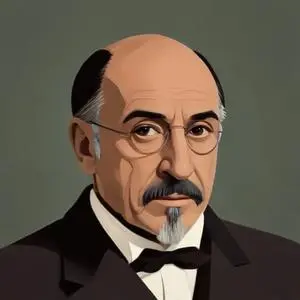
A renowned Italian writer who crafted innovative, psychologically complex works that explored the human condition, earning him the Nobel Prize in Literature. His plays and novels continue to influence modern theatre and literature.
Luigi Pirandello, an Italian dramatist, novelist, poet, and short story writer, is renowned for his bold and ingenious revival of dramatic and scenic art, earning him the prestigious 1934 Nobel Prize in Literature. His profound influence on modern theatre is evident in his pioneering work, which paved the way for the Theatre of the Absurd movement.
Born on June 28, 1867, in Caos, a small village near Porto Empedocle, Sicily, Pirandello grew up in an upper-class family with a strong sense of idealism. His parents, Stefano Pirandello and Caterina Ricci Gramitto, were both involved in the struggle for unification and democracy, and their ferocious anti-Bourbon sentiments had a lasting impact on Pirandello's worldview.
Pirandello's early life was marked by a fascination with literature and the arts. He began writing at a young age, publishing his first collection of poems, Mal Giocondo, in 1889. However, it was his move to Rome in 1891 that truly sparked his creative journey. He became immersed in the city's vibrant literary circle, befriending prominent writers and intellectuals of the time.
In the early 1900s, Pirandello's focus shifted towards theatre, and he began to develop his signature style, characterized by a blend of tragedy and farce. His plays, often written in Sicilian, challenged traditional dramatic structures and explored the complexities of human identity. Six Characters in Search of an Author (1921) and Henry IV (1922) are two of his most notable works, showcasing his innovative approach to storytelling.
Pirandello's groundbreaking contributions to literature and theatre earned him numerous awards and accolades. In 1934, he was awarded the Nobel Prize in Literature, recognizing his "bold and ingenious revival of dramatic and scenic art." He was also honored with the Italian Royal Academy's highest award, the Premio Mussolini, in 1935.
Pirandello's impact on modern theatre and literature is immeasurable. His avant-garde approach to storytelling and his exploration of the human condition paved the way for future generations of writers and playwrights. The Theatre of the Absurd movement, which emerged in the 1950s, owes a significant debt to Pirandello's innovative work.
Today, Pirandello's works continue to be celebrated for their depth, complexity, and innovative storytelling. His novels, short stories, and plays remain a testament to his boundless creativity and his ability to challenge and subvert traditional literary forms.
Luigi Pirandello's bold and imaginative approach to literature and theatre continues to inspire and influence writers, playwrights, and artists around the world. His legacy is a testament to the power of creative rebellion and the importance of pushing boundaries in the pursuit of artistic innovation.
Born in 1863
A flamboyant and provocative Italian artist, known for his bold and innovative works that blended literature, politics, and drama, inspiring a generation of artists and intellectuals.
Born in 1861
A pioneering figure in modernist literature, known for his influential novels of psychological insight, particularly "The Confessions of Zeno".
Born in 1896
A renowned Italian poet and translator, celebrated for his unique and expressive style that explores the human condition, earning him the Nobel Prize in Literature.
Born in 1901
An Italian writer who crafted powerful, symbolic poetry and novels that explored the human condition, earning him the Nobel Prize in Literature in 1959.
Born in 1785
Wrote influential novels that helped shape the modern Italian language and identity, particularly with his iconic work "I Promessi Sposi" (The Betrothed).
Born in 1871
A renowned Italian writer, celebrated for her poignant and evocative works that explored the human condition, particularly the lives of Sardinian women. Her writing often delved into themes of love, family, and social change.
