


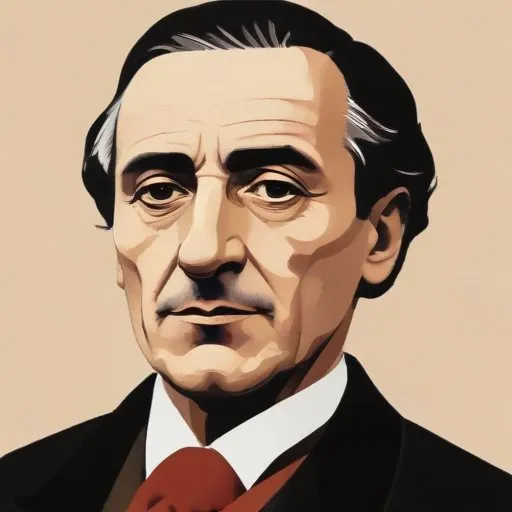
A renowned Italian poet and classical scholar, he's celebrated for his lyrical and symbolic poetry, as well as his groundbreaking work in classical philology.
Giovanni Pascoli, an esteemed Italian poet, classical scholar, and literary icon, is renowned for his captivating works that evoke a sense of childhood wonder and introspection. Through his poetry, he redefined the boundaries of traditional Italian literature, infusing it with a unique blend of symbolism, spiritualism, and classical influences.
Giovanni Pascoli was born on December 31, 1855, in San Mauro di Romagna, Italy. His life took a tragic turn when his father, Ruggero Pascoli, was brutally murdered in 1867, an event that would leave an indelible mark on Pascoli's psyche and later influence his poetry.
In 1897, Pascoli published his debut collection, Il Fanciullino, which showcased his distinctive style and cemented his position as a leading figure in Italian literature. This work introduced the concept of "childishness" as a poetic ideal, highlighting the importance of simplicity, innocence, and everyday life.
Pascoli's literary style was shaped by his classical education, which he received from his teacher, Giosuè Carducci. However, he also exhibited a strong affinity for decadent themes, characteristic of the fin-de-siècle era. This blend of influences resulted in a unique poetic voice that navigated the realms of tradition and innovation.
Pascoli believed that poetry held a moral and civic value, serving as a consolatory force in times of turmoil. He saw the poet as a guardian of childhood innocence, tasked with preserving the primal and emotional connections that bind humanity.
Pascoli's poetry has had a profound impact on Italian literature, influencing generations of writers and poets. His emphasis on the importance of childhood, simplicity, and everyday life has resonated with readers worldwide, making him a beloved and respected figure in literary circles.
Pascoli's close friendship with fellow poet, Gabriele D'Annunzio, is well-documented. The two poets shared a deep appreciation for classical literature and decadent themes, often engaging in lively debates about the nature of poetry and its role in society.
Giovanni Pascoli's enduring legacy is a testament to the power of poetry to capture the human experience. Through his work, he continues to inspire generations of readers, writers, and poets, reminding us of the importance of simplicity, innocence, and the beauty of childhood.
Born in 1863
A flamboyant and provocative Italian artist, known for his bold and innovative works that blended literature, politics, and drama, inspiring a generation of artists and intellectuals.
Born in 1896
A renowned Italian poet and translator, celebrated for his unique and expressive style that explores the human condition, earning him the Nobel Prize in Literature.
Born in 1901
An Italian writer who crafted powerful, symbolic poetry and novels that explored the human condition, earning him the Nobel Prize in Literature in 1959.
Born in 1888
An Egyptian-Italian soldier, journalist, and poet who explored the human condition through surreal and symbolic verse, influencing 20th-century modernist poetry. His work is a testament to the power of language in capturing the essence of war and existence.
Born in 1861
A pioneering figure in modernist literature, known for his influential novels of psychological insight, particularly "The Confessions of Zeno".
Born in 1867
A renowned Italian writer who crafted innovative, psychologically complex works that explored the human condition, earning him the Nobel Prize in Literature. His plays and novels continue to influence modern theatre and literature.
Born in 1785
Wrote influential novels that helped shape the modern Italian language and identity, particularly with his iconic work "I Promessi Sposi" (The Betrothed).
