


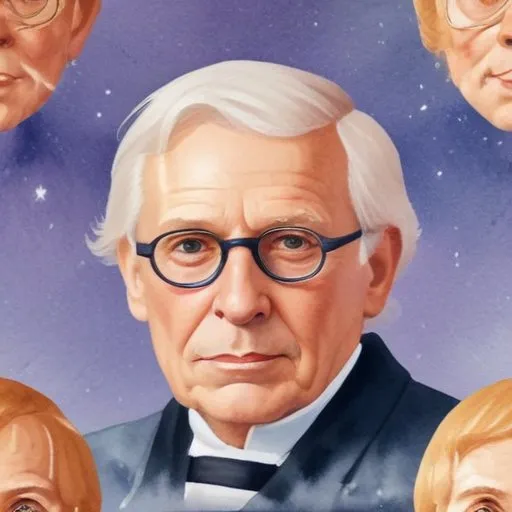
A pioneer in planetary atmosphere studies, known for proposing the existence of carbon dioxide on Venus and methane on Jupiter, revolutionizing our understanding of our solar system.
Rupert Wildt's work serves as a testament to human curiosity and the boundless potential of scientific inquiry, reminding us of the importance of exploring the unknown and pushing the boundaries of human knowledge.
Born in 1885
Measured the galaxy's size and mapped the Milky Way's structure, revolutionizing our understanding of the universe.
Born in 1900
Pioneering astronomer who discovered that stars are primarily composed of hydrogen and helium, revolutionizing our understanding of the universe. Her groundbreaking work paved the way for future generations of astronomers.
Born in 1910
A renowned scientist who pioneered our understanding of black holes and the behavior of stars, earning a Nobel Prize in Physics in 1983.
Born in 1882
A pioneer in astrophysics, he formulated the Eddington limit, a crucial concept in understanding stars, and was a key figure in popularizing Einstein's theory of relativity. His work bridged the gap between theory and observation in astronomy.
Born in 1906
A renowned physicist and Nobel laureate who made groundbreaking contributions to our understanding of the universe, particularly in the fields of nuclear physics and astrophysics.
Born in 1898
A pioneer in astrophysics and cosmology, he proposed the existence of dark matter and dark energy, revolutionizing our understanding of the universe's structure and evolution.
Born in 1873
Developed the Hertzsprung-Russell diagram, a fundamental tool in astronomy that relates stars' brightness to their color and temperature. This diagram revolutionized our understanding of stars and their life cycles.
