


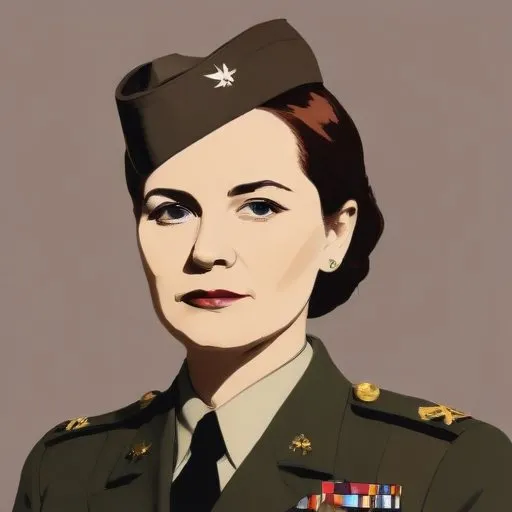
First female Marine Corps colonel, pioneering women's integration in the military, and breaking gender barriers.
Ruth Cheney Streeter is renowned for being the first director of the United States Marine Corps Women's Reserve (USMCWR) and the first woman to attain the rank of major in the United States Marine Corps. Her remarkable achievements paved the way for future generations of women in the military.
Ruth Cheney was born on October 2, 1895, in Brookline, Massachusetts. She graduated from Bryn Mawr College in 1918, showcasing her academic prowess and determination. On June 23, 1917, she married Thomas W. Streeter, and they went on to have four children.
Ruth Streeter was an active participant in civic affairs, serving as the first woman president of the Morris County, New Jersey Welfare Board. Her commitment to public service and leadership was evident even before her military career.
At the age of 47, Streeter obtained her commercial pilot's license, intending to join either the WAVES or the Women Airforce Service Pilots (WASPS) as a ferry pilot in the war effort. Despite being rejected five times by the WASPS due to her age, Streeter persevered and joined the United States Marine Corps Women's Reserve instead.
On January 29, 1943, Streeter was commissioned as a major and appointed director of the United States Marine Corps Women's Reserve. This milestone marked the beginning of her illustrious career, as she oversaw the growth of the Women's Reserve from its inception to its peak strength of 831 officers and 17,714 enlisted personnel.
Streeter's exceptional leadership and service were recognized with the Legion of Merit on October 31, 1945. The accompanying citation praised her energy, force, tact, and dedication to the Women's Reserve.
Ruth Cheney Streeter's pioneering spirit and trailblazing achievements have left an indelible mark on the history of women in the military. Her courage and perseverance have inspired countless women to pursue careers in the armed forces, breaking down barriers and paving the way for future generations.
Ruth Cheney Streeter's remarkable achievements must be viewed within the historical context of World War II, when the role of women in the military was rapidly evolving. Her leadership and dedication played a crucial role in the development of the Women's Reserve, paving the way for future generations of women to serve in the armed forces.
Born in 1890
Led the Allied forces to victory in World War II and later served as President, maintaining peace and prosperity during the Cold War era. He's known for his strategic leadership and diplomatic skills.
Born in 1880
A highly decorated military leader and statesman who played a crucial role in shaping post-WWII foreign policy and was awarded the Nobel Peace Prize for his efforts. He's most known for authoring the Marshall Plan, a massive economic aid program that helped rebuild war-torn Europe.
Born in 1893
Led the US Army in World War II and became the last five-star general, playing a crucial role in shaping post-war American military strategy. He's also known for his humble and unassuming leadership style.
Born in 1880
A highly decorated war hero and master strategist who led troops to victory in World War I and II, and later became a prominent figure in the occupation of Japan.
Born in 1885
Led the U.S. Pacific Fleet to victory in World War II, playing a crucial role in defeating Japan and ending the war. He was a highly respected and decorated naval leader.
Born in 1885
A renowned military leader who played a crucial role in World War II, particularly in the Allied victory in Europe, known for his bold tactics and unapologetic style.
