


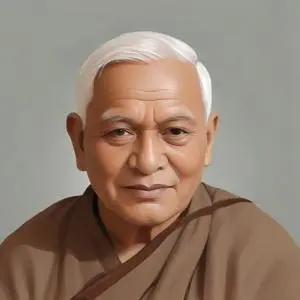
A renowned meditation teacher who popularized Vipassana, a mindfulness technique rooted in ancient Indian wisdom, making it accessible to people worldwide.
S. N. Goenka is renowned for being a visionary Indian teacher of Vipassana meditation, who played a pivotal role in popularizing this ancient practice globally. He is credited with establishing non-commercial Vipassana meditation centers worldwide, emphasizing the universal, scientific, and non-sectarian nature of the Buddha's path to liberation.
Born on January 30, 1924, in Burma (now Myanmar) to Indian parents from the Marwari ethnic group, Goenka grew up in a conservative Hindu household. He was a successful businessman, but his life took a dramatic turn in 1955 when he started experiencing severe, debilitating migraines. Unable to find medical relief, he turned to Vipassana meditation under the guidance of Sayagyi U Ba Khin, a renowned Burmese meditation teacher.
Goenka trained under Sayagyi U Ba Khin for 14 years, and in 1969, he was authorized to teach Vipassana meditation. This marked the beginning of his remarkable journey, which would take him from being a successful businessman to a pioneering meditation teacher. He left his business to his family and moved to India, where he established the first Vipassana meditation center at Kusum Nagar in Hyderabad.
Today, Vipassana courses, in the tradition of Sayagyi U Ba Khin, are held at 380 locations in 94 countries, with about 241 permanent centers. Goenka's teachings have transcended geographical and cultural boundaries, making Vipassana meditation a household name. His emphasis on the scientific, universal, and non-sectarian nature of Vipassana has made it accessible to people from diverse backgrounds and faiths.
In recognition of his outstanding contributions to the propagation of Vipassana meditation, Goenka was awarded the Padma Bhushan by the Government of India in 2012. This prestigious award is given for distinguished service of high order in various fields.
In 1976, Goenka established his first meditation center, Dhamma Giri, in Igatpuri, near Nashik, Maharashtra. This center has since become a hub for Vipassana meditation, attracting students from around the world.
In 1985, he established the Vipassana Research Institute at Dhamma Giri, which has become a center for research, publication, and dissemination of Vipassana-related literature and materials.
Goenka's teachings have had a profound impact on modern society, inspiring countless individuals to adopt a more mindful, compassionate, and peaceful way of living. His emphasis on the scientific and universal nature of Vipassana has made it an attractive practice for people from diverse backgrounds and faiths.
Today, Vipassana meditation is practiced by people from all walks of life, including business leaders, artists, educators, and healthcare professionals, who seek to cultivate greater awareness, clarity, and inner peace in their daily lives.
Goenka's teachings have been compiled into numerous books, audio, and video recordings, which are widely available. Some of his notable works include:
S. N. Goenka's remarkable life journey and teachings have left an indelible mark on the world of Vipassana meditation, inspiring countless individuals to embark on a path of self-discovery, compassion, and wisdom.
Born in 1869
Indian freedom fighter, activist, and philosopher who led India to independence from British rule through non-violent civil disobedience, inspiring civil rights movements worldwide.
Born in 1889
India's first Prime Minister, a key figure in the country's struggle for independence from British rule, and a champion of democracy and secularism. He played a crucial role in shaping modern India's government and economy.
Born in 1884
India's first president, a key figure in the country's struggle for independence, who played a crucial role in shaping the nation's early years. He's revered for his leadership and commitment to democracy.
Born in 1888
An Indian philosopher and politician who served as the 2nd President of India, known for his influential writings on Indian philosophy and his role in shaping India's education system.
Born in 1896
Fourth Prime Minister of India, known for his efforts to decentralize power and promote economic development, and for being the first Indian Prime Minister to resign from office.
Born in 1909
A Burmese educator and diplomat who served as the 3rd United Nations Secretary-General, mediating international conflicts and promoting global cooperation. He's known for his quiet diplomacy and leadership during the Cold War era.
