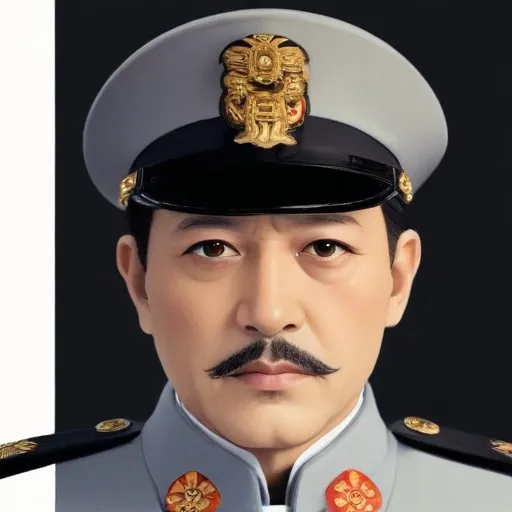
Sadae Inoue

Sadae Inoue

Sadae Inoue was born on November 5th, 1886

Nationality: Japanese
Occupation: General
Profession: Military Officer
Place of Birth: Japan
Ethnicity: Japanese
Notable Work: Japanese Army
Rank: General
Service Years: 1894-1945

A Japanese general who served during the Russo-Japanese War and later became a prominent figure in the development of the Imperial Japanese Army, known for his military strategies and reforms.

Written by: Emily Carter Emily Carter

A Commander of Unwavering Resolve> Sadae Inoue was a Japanese general who commanded the Japanese forces during the grueling battles of Peleliu and Angaur in World War II. Known for his unrelenting defense of the Palau Islands, Inoue's leadership was marked by his determination to hold off the Allied forces, despite being vastly outnumbered.

Early Life and Education> Born on November 5, 1886, in Kumamoto prefecture, Japan, Inoue was the third son of a local police officer. He attended military preparatory schools and graduated from the 20th class of the Imperial Japanese Army Academy in 1908.

Military Career> Inoue's military career spanned over three decades, during which he served in several key conflict zones. He was assigned to the IJA's 44th Infantry Regiment and participated in Japan's Siberian Intervention against Bolshevik forces in eastern Russia. During the Second Sino-Japanese War, Inoue was commander of the IJA's 5th Infantry Regiment.

Rise Through the Ranks> Inoue's rise through the ranks was steady and marked by key promotions. He was commissioned as a major general in March 1939 and became commander of the IJA 33rd Division. In 1941, he was attached to the headquarters staff of the Taiwan Army of Japan. His promotion to lieutenant general in 1942 cemented his position as a senior military leader.

The Defense of Palau> In 1943, Inoue was tasked with the defense of Palau by General Hideki Tojo. He assumed command of the 14th Division, which was stationed in Manchukuo, and led his troops in the brutal battles of Angaur and Peleliu. Despite being vastly outnumbered, Inoue's forces put up a fierce resistance, earning him recognition as a formidable military commander.

The Battle of Peleliu> The Battle of Peleliu was one of the bloodiest battles fought during World War II. Inoue's 14th Division, consisting of approximately 10,000 soldiers, was tasked with defending the island against the 1st Marine Division of the United States. The battle lasted from September 15 to November 27, 1944, and resulted in heavy casualties on both sides.

The Battle of Angaur> The Battle of Angaur was fought from September 17 to October 22, 1944, and marked the first major battle fought by Inoue's 14th Division. The battle was intense, with both sides suffering heavy losses.

Legacy> Inoue's defense of Palau, although ultimately unsuccessful, earned him recognition as a skilled military commander. His unwavering resolve and determination to hold off the Allied forces, despite being vastly outnumbered, have become a testament to his leadership and bravery.

Personal Life> Little is known about Inoue's personal life, as he remained a private figure throughout his military career. He passed away on October 26, 1961, leaving behind a legacy as a dedicated and resolute military commander.

Key Dates>
  • November 5, 1886: Born in Kumamoto prefecture, Japan
  • 1908: Graduated from the Imperial Japanese Army Academy
  • 1939: Promoted to major general
  • 1942: Promoted to lieutenant general
  • 1943: Assumed command of the 14th Division
  • 1944: Led the defense of Palau during the Battle of Peleliu and Angaur
  • October 26, 1961: Passed away

Final Thoughts> Sadae Inoue's legacy as a military commander is a testament to his bravery, determination, and unwavering resolve. His defense of Palau, although ultimately unsuccessful, remains an important chapter in the history of World War II.

Timeline
1886
Born in Japan
Sadae Inoue was born on November 5, 1886, in Tokyo, Japan. He would go on to become a prominent general and politician.
1907
Graduates from Military Academy
Inoue graduated from the Imperial Japanese Army Academy and began his military career.
1920
Becomes Chief of Staff
Inoue became the chief of staff of the Japanese army, playing a key role in Japans military expansion during World War II.
1945
Surrenders to Allied Forces
Inoue surrendered to Allied forces in September 1945, marking the end of Japans involvement in World War II.
1961
Dies in Japan
Sadae Inoue died on April 29, 1961, at the age of 74, leaving behind a complex legacy as a military leader and politician.
Sadae Inoue

Sadae Inoue Quiz

What was Sadae Inoue's role during the Russo-Japanese War?

Score: 0/5
FAQ
What was Sadae Inoues role in the Japanese military?
Sadae Inoue was a Japanese general who played a significant role in the Imperial Japanese Army during World War II. He served as the commander of the Japanese 13th Division and was involved in several key battles, including the Battle of Wuhan and the Battle of Nanjing.
What were Sadae Inoues contributions to the Japanese war effort?
Sadae Inoue made significant contributions to the Japanese war effort, including leading troops in numerous battles and serving as a key strategist for the Imperial Japanese Army. His military campaigns helped to expand Japans territorial control in Asia.
What is known about Sadae Inoues early life?
Little is known about Sadae Inoues early life, but it is believed that he was born in the late 19th century and graduated from the Imperial Japanese Army Academy. He quickly rose through the ranks, becoming a respected and feared military leader.
Did Sadae Inoue face any criticism or controversy during his military career?
Yes, Sadae Inoue faced criticism and controversy during his military career, particularly for his role in the Nanking Massacre, a brutal assault on civilians and prisoners of war in Nanjing, China. He was accused of war crimes and faced international scrutiny.
What was Sadae Inoues fate after World War II?
After Japans defeat in World War II, Sadae Inoue was arrested and tried for war crimes by the Allied powers. He was found guilty and sentenced to life imprisonment, but died in prison in 1954.

Related People:

Hirohito

Born in 1901

The Japanese emperor who ruled from 1926 to 1989, leading the country through World War II and its post-war reconstruction, and is known for his symbolic role in Japanese politics and culture. He is also remembered for his rare public apology for Japan's wartime atrocities.

Isoroku Yamamoto

Born in 1884

Led the Imperial Japanese Navy during World War II, masterminding the surprise attack on Pearl Harbor, and later became a symbol of Japanese military power and strategy.

Akiyama Yoshifuru

Born in 1859

A pioneering military leader who modernized Japan's cavalry and played a key role in the country's early 20th-century wars, earning him the nickname "Father of Japanese Cavalry."