


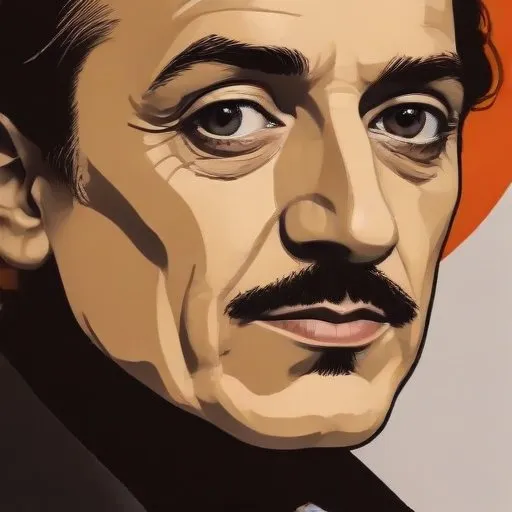
A Catalan literary giant, renowned for crafting poignant, symbolic works that explored the human condition, Catalan identity, and the struggle for independence. His writings often blended myth, history, and fantasy.
Salvador Espriu, a renowned Catalan poet from Spain, is known for his extraordinary ability to intertwine myth and reality, creating a unique narrative voice that resonated with readers worldwide. His literary contributions earned him numerous accolades, including the prestigious Montaigne Prize in 1971, and cemented his position as one of the most influential Catalan writers of the 20th century.
Born on July 10, 1913, in Santa Coloma de Farners, Catalonia, Spain, Espriu was the son of an attorney. His childhood was spent between his hometown, Barcelona, and Arenys de Mar, a village on the Maresme coast, which would later inspire many of his works. At the age of 16, he published his first book, Israel, written in Spanish, showcasing his early affinity for literature.
During his university years at the University of Barcelona, where he studied law and ancient history, Espriu's travels to Egypt, Greece, and Palestine in 1933 profoundly influenced his writing. His exposure to the cradle of classical myths would become a signature element in his work, blending mythology with everyday life.
Espriu's literary journey began with the publication of El doctor Rip (1931) and Laia (1932), novels that diverged from the dominant aesthetic formulas of the Catalan Noucentisme movement. These early works demonstrated his unique narrative voice, oscillating between grotesque distortion and lyrical aestheticism.
His subsequent publications, Aspectes (1934), Ariadna al laberint grotesc (1935), and Miratge a Citera (1935), solidified his reputation as a master storyteller. These works showcased his ability to synthesize realism with the linguistic tutelage of Spanish-language modernists such as Valle-Inclán and Gabriel Miró.
Throughout his career, Espriu received numerous awards and honors, including:
In addition, he was awarded honorary doctorates from the universities of Toulouse and Barcelona.
Salvador Espriu's literary legacy extends beyond his native Catalonia, with his works translated into multiple languages and earning international recognition. His unique blend of mythology and realism has inspired generations of writers and continues to captivate readers today.
His influence can be seen in the works of contemporaries such as Joan Brossa and Mercè Rodoreda, and his impact on Catalan literature is immeasurable. Espriu's poetic voice, woven from the threads of myth and reality, continues to resonate, ensuring his place in the pantheon of great Catalan writers.
Salvador Espriu passed away on February 22, 1985, in Barcelona, and was laid to rest in the Arenys de Mar cemetery, which inspired his poem Cementiri de Sinera. His legacy, however, lives on, a testament to the power of his imagination and the boundless creativity that has captivated readers for generations.
Born in 1899
A visionary writer who crafted intricate, philosophical tales that blurred reality and fantasy, influencing generations of authors and thinkers. 82
99 Years Old
A Colombian journalist and author who crafted magical realism, a literary style that blends fantasy and reality, and won the Nobel Prize in Literature in 1982. His works are known for their vivid storytelling and exploration of human experience.
Born in 1904
A Chilean poet and diplomat who wrote passionate and evocative poetry that explored love, politics, and the human condition, and was awarded the Nobel Prize in Literature in 1971.
Born in 1898
A Spanish poet, playwright, and director who explored themes of love, death, and Spanish culture through his works, including the famous play "Blood Wedding".
Born in 1898
A Spanish poet and author, celebrated for his surreal and introspective works that explored the human condition, earning him the Nobel Prize in Literature in 1977.
Born in 1916
A Spanish writer and politician who won the Nobel Prize in Literature in 1989 for his innovative and influential literary style, which explored the human condition and Spanish culture.
Born in 1864
A Spanish philosopher and author who explored the human condition, faith, and the search for meaning in life, creating influential works that continue to resonate with readers today.
Born in 1845
A 19th-century Catalan priest and poet who wrote influential works that helped establish Catalan as a literary language, earning him the title "National Poet of Catalonia".
