


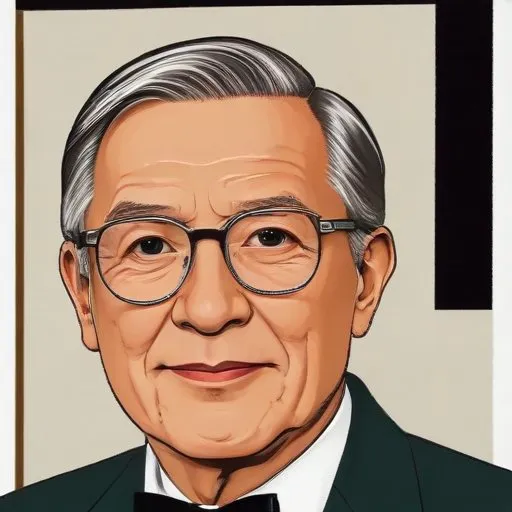
A Nobel Prize-winning physicist who discovered the J/? particle, a subatomic particle that helped confirm the existence of quarks, revolutionizing our understanding of matter.
Samuel C. C. Ting, a renowned American physicist, made history by discovering the subatomic J/ψ particle, earning him the Nobel Prize in Physics in 1976, along with Burton Richter. This groundbreaking find revolutionized the field of particle physics, propelling Ting to the forefront of scientific research.
Born on January 27, 1936, in Ann Arbor, Michigan, to first-generation Chinese immigrant parents, Ting was homeschooled by his parents throughout World War II. After the communist takeover of mainland China, Ting's family moved to Taiwan in 1949, where he conducted most of his formal schooling.
In 1956, Ting returned to the United States at the age of 20, barely speaking English, and attended the University of Michigan. He went on to study engineering, mathematics, and physics, earning Bachelor of Science in Engineering degrees in mathematics and physics in 1959 and a Doctor of Philosophy degree in physics in 1962.
Ting's remarkable career has been punctuated by prestigious appointments and groundbreaking discoveries. In 1963, he worked at the European Organization for Nuclear Research (CERN), and from 1965, he taught at Columbia University in the City of New York and worked at the Deutsches Elektronen-Synchrotron (DESY) in Germany. Since 1969, Ting has been a professor at the Massachusetts Institute of Technology (MIT).
His most notable achievement, the discovery of the J/ψ particle, was made possible by his work at the Brookhaven National Laboratory's Alternating Gradient Synchrotron. This discovery led to a deeper understanding of quark interactions and the behavior of subatomic particles.
Ting's work has had a profound impact on modern physics, shaping our understanding of the universe and inspiring future generations of scientists. His contributions to the field of particle physics have paved the way for new discoveries and innovations.
Today, Ting continues to be involved in cutting-edge research, serving as the principal investigator for the Alpha Magnetic Spectrometer (AMS) on the International Space Station. The AMS aims to uncover the mysteries of the universe, searching for evidence of dark matter and antimatter.
Throughout his illustrious career, Ting has demonstrated a deep commitment to education and public service. He has inspired countless students and young scientists, promoting the importance of science education and literacy.
Ting's remarkable journey serves as a testament to the power of human curiosity, perseverance, and dedication. His groundbreaking discoveries and contributions to the world of physics have left an indelible mark on our understanding of the universe and our place within it.
93 Years Old
Developed a unified theory of electromagnetism and the weak nuclear force, predicting the existence of neutral currents. This work led to a deeper understanding of subatomic particles and their interactions.
93 Years Old
A Nobel Prize-winning physicist who pioneered the electroweak force theory, a fundamental concept in modern particle physics. His work unified two of the four fundamental forces of nature, revolutionizing our understanding of the universe.
Born in 1922
A Nobel Prize-winning physicist and mathematician who discovered the muon neutrino, a subatomic particle, and made significant contributions to our understanding of the universe. His work has far-reaching implications for particle physics and beyond.
97 Years Old
A pioneer in particle physics, discovering subatomic particles like quarks and gluons, and developing the theory of quantum chromodynamics.
80 Years Old
A Dutch physicist and academic who pioneered work on black holes and quantum mechanics, earning a Nobel Prize in Physics in 1999.
75 Years Old
A mathematician and physicist who pioneered the concept of asymptotic freedom, a fundamental aspect of quantum chromodynamics, and was awarded the Nobel Prize in Physics in 2004. His work has significantly advanced our understanding of the strong nuclear force.
75 Years Old
A renowned theoretical physicist and professor, known for his groundbreaking work on superstring theory and its application to cosmology and particle physics.
