


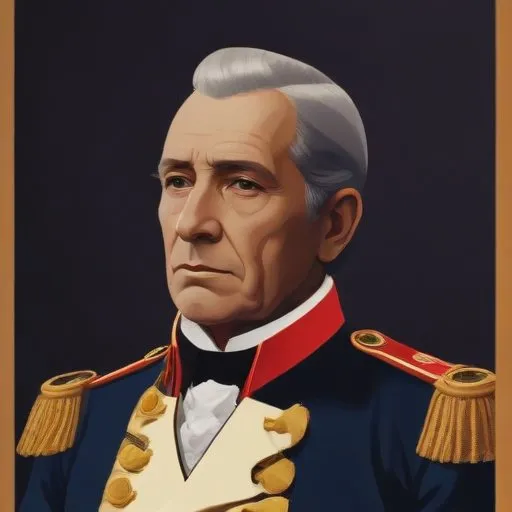
American Revolutionary War general who served as Adjutant General of the Continental Army and played a key role in organizing and training the army.
Samuel Cooper, an American career Army staff officer, is best known for being the highest-ranking general officer in the Confederate States Army during the American Civil War, even outranking the legendary Robert E. Lee. Born on June 12, 1798, in New Hackensack, Dutchess County, New York, Cooper's illustrious military career spanned over four decades.
Cooper entered the United States Military Academy at the tender age of 15 in 1813. He graduated 36th in a class of 40 two years later, which was the standard length of study during that period. This marked the beginning of his remarkable journey in the military.
Cooper's military career was characterized by steady promotions and notable appointments. He was appointed a brevet second lieutenant in the U.S. Light Artillery on December 11, 1815, and later promoted to first lieutenant in 1821 and captain in 1836. In 1828, he served as aide-de-camp for Gen. Alexander Macomb, under whose supervision he authored A Concise System of Instructions and Regulations for the Militia and Volunteers of the United States.
Cooper served in numerous artillery units until 1837, when he was appointed chief clerk of the U.S. War Department. He received a brevet promotion to major in 1838 and was appointed assistant adjutant general of the Army. In 1847, he was promoted to lieutenant colonel and served in the same capacity.
Cooper's service in the Second Seminole War (1841-1842) marked a rare departure from his staff duties in Washington, D.C. He was chief of staff for Col. William J. Worth, demonstrating his exceptional leadership skills. After the war, he returned to staff duty in Washington from 1842 to 1845.
During the American Civil War, Cooper served as the highest-ranking general officer in the Confederate States Army, surpassing even Robert E. Lee. Despite this distinction, he remained largely behind the scenes, working closely with Confederate President Jefferson Davis and other high-ranking officials.
After the war, Cooper settled in Virginia, where he lived as a farmer. He remained in this quiet life until his passing on December 3, 1876. Despite his remarkable achievements, Cooper remained humble and unassuming, earning the respect of his peers and contemporaries.
Samuel Cooper's legacy is one of dedication, hard work, and leadership. His remarkable military career serves as a testament to his exceptional abilities and strategic thinking. As the highest-ranking general officer in the Confederate States Army, Cooper played a pivotal role in shaping the course of American history.
Samuel Cooper's remarkable life and achievements continue to inspire and educate us about the complexities of American history and the importance of leadership, dedication, and humility.
Born in 1786
Led the United States Army to victory in the Mexican-American War and was a presidential candidate in 1852, known for his military strategy and leadership.
Born in 1784
The 12th President of the United States was a military hero who led the country to victory in the Mexican-American War, and later became a short-lived president. He's known for his strong leadership and sudden death in office.
Born in 1822
Led the Union Army to victory in the Civil War and later became President, known for issuing the Emancipation Proclamation and strengthening federal authority.
Born in 1807
Led the Confederate States Army during the American Civil War, surrendering to Union forces at Appomattox, marking the war's effective end.
Born in 1826
A Union general during the American Civil War, he's infamous for his cautious tactics and disagreements with President Lincoln, later becoming a governor of New Jersey.
Born in 1824
A Union general during the American Civil War, known for his distinctive sideburns and leading the Army of the Potomac to a disastrous defeat at the Battle of Fredericksburg.
Born in 1814
Union general who played a crucial role in the American Civil War, particularly at the Battle of Chancellorsville and Gettysburg.
Born in 1815
Led the Union Army to victory in the Battle of Gettysburg, a turning point in the American Civil War, and later oversaw the construction of the Washington Aqueduct.
