


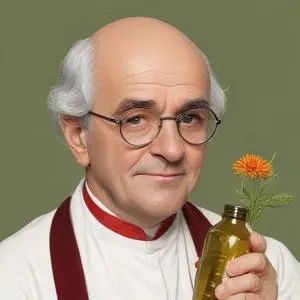
Developed homeopathy, a system of alternative medicine that uses highly diluted substances to treat diseases. This approach emphasizes individualized treatment and the body's natural healing abilities.
Samuel Hahnemann is renowned for creating the pseudoscientific system of alternative medicine known as homeopathy. This German physician's work laid the foundation for a controversial yet widely practiced form of medicine that has been shaping healthcare for over two centuries.
Hahnemann was born on April 10, 1755, in Meissen, Saxony, near Dresden, Germany. His father, Christian Gottfried Hahnemann, was a painter and designer of porcelain, for which the town of Meissen is famous. From a young age, Hahnemann demonstrated a remarkable aptitude for languages, becoming proficient in English, French, Italian, Greek, and Latin.
He later honed his skills as a translator and teacher of languages, adding Arabic, Syriac, Chaldaic, and Hebrew to his repertoire. This linguistic expertise would serve him well in his future medical pursuits.
Hahnemann's medical education took him to Leipzig, where he studied for two years, and later to Vienna, where he spent ten months studying under the guidance of esteemed physician Joseph von Quarin. After completing his studies, Hahnemann graduated with a medical degree with honors from the University of Erlangen on August 10, 1779.
Hahnemann's medical practice took him to the copper-mining area of Mansfeld, Saxony, where he worked as a village doctor. It was during this period that he began to develop his theories on homeopathy, which would eventually lead to a paradigm shift in the way people approached medicine.
In 1790, Hahnemann published his groundbreaking work, "Organon of the Rational Art of Healing," which laid the foundation for homeopathy. This treatise introduced the concept of "like cures like," which posits that a substance capable of causing symptoms in a healthy person can be used to treat similar symptoms in a person who is ill.
Hahnemann's work in homeopathy was deeply rooted in his philosophical beliefs about the nature of health and disease. He believed that the human body has an innate ability to heal itself and that the role of the physician is to assist this process. He also believed that disease is a dynamic, spiritual process that requires a holistic approach to treatment.
Hahnemann's emphasis on the individualization of treatment and the use of highly diluted substances to treat disease paved the way for a unique approach to healthcare.
Homeopathy, as a system of medicine, has had a significant impact on modern society. Today, homeopathic remedies are used by millions of people around the world, and many conventional medical practitioners are incorporating homeopathic principles into their practice.
Hahnemann's work has also inspired a wide range of holistic and alternative therapies, from acupuncture to naturopathy, that focus on treating the whole person rather than just the symptoms of disease.
Hahnemann married Johanna Henriette Kuchler in 1782 and had eleven children with her. He spent many years traveling throughout Saxony, staying in various towns and villages, and it was during this period that he developed his ideas on homeopathy.
Hahnemann's life was marked by a deep commitment to his work and a passion for helping others. He continued to practice and develop homeopathy until his death on July 2, 1843, at the age of 88.
Hahnemann's legacy is complex and multifaceted. While his work in homeopathy has been widely criticized by the scientific community, it has also inspired a grassroots movement towards holistic healthcare that continues to grow and evolve.
Hahnemann's work must be viewed within the historical context of the late 18th and early 19th centuries, when the medical profession was still in its infancy. His pioneering work in homeopathy paved the way for a more nuanced understanding of the intricate relationships between mind, body, and environment.
Today, Hahnemann is remembered as a visionary who challenged the conventional wisdom of his time and inspired a new generation of healthcare practitioners to think differently about the nature of health and disease.
Born in 1734
A German physician and astrologer who developed a theory of "animal magnetism" and is considered the father of hypnosis, known for his controversial and influential ideas about the power of the mind.
Born in 1743
Father of modern chemistry, discovered oxygen, and developed a systematic method of chemical nomenclature. He laid the foundation for modern chemistry and paved the way for future scientific discoveries.
Born in 1707
Developed the system of binomial nomenclature, which is still used today to classify and name living organisms. This system has had a profound impact on the fields of biology, ecology, and conservation.
Born in 1744
A French soldier, biologist, and academic who developed a theory of inheritance of acquired characteristics, proposing that organisms adapt to their environment and pass on those traits to their offspring.
Born in 1769
Founded the field of comparative anatomy, establishing extinction as a fact and creating a framework for understanding the natural world through fossil records.
Born in 1514
A pioneering figure in the study of human anatomy, known for performing detailed dissections and creating accurate drawings of the body's inner workings, revolutionizing medical understanding.
Born in 1668
A Dutch botanist and physician who laid the foundations for modern medicine by emphasizing clinical observation, experimentation, and scientific rigor, and is considered the father of physiology.
Born in 1821
A pioneer in modern medicine, he founded the field of social medicine, emphasizing the importance of social and environmental factors on health, and made significant contributions to cellular pathology.
