


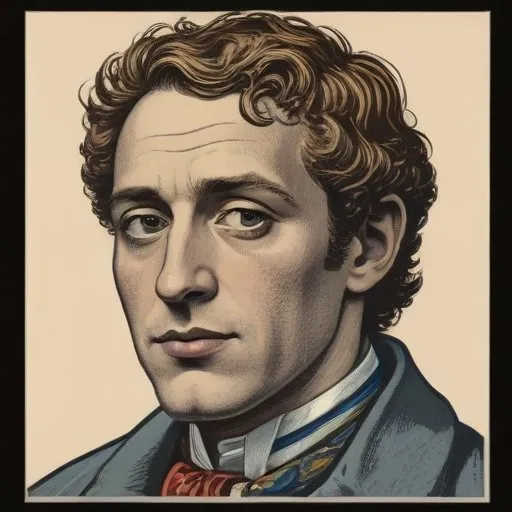
A Romantic-era artist celebrated for his dreamlike, mystical landscapes and etchings that blended realism with fantasy. His work often featured rural scenes, symbolism, and a sense of the sublime.
Samuel Palmer, a British landscape painter, etcher, and printmaker, is renowned for his visionary pastoral paintings that captivated the essence of Romanticism in Britain. His mesmerizing works, often depicted in sepia shades under moon and starlight, transported viewers to an idyllic world of mystery and wonder.
Born on January 27, 1805, in Surrey Square, London, Palmer's life was marked by tragedy when his mother, Martha, passed away suddenly in 1818. This event had a profound impact on the young Palmer, who wrote, "It was like a sharp sword sent through the length of me." Despite the challenges, Palmer's love for art persevered, and he began painting churches at the tender age of twelve.
In 1824, Palmer's life took a significant turn when he met the enigmatic William Blake, whose influence would shape his artistic style for the next decade. Through their association, Palmer's work began to exhibit the mystical and symbolic themes characteristic of Blake's style.
In 1826, Palmer purchased a rundown cottage in Shoreham, near Sevenoaks in Kent, which he affectionately dubbed "Rat Abbey." It was here that he created some of his most iconic works, depicting the area as a mystical and visionary place, often under the soft glow of moonlight. This period marked the beginning of Palmer's association with a group of Blake-influenced artists known as the Ancients, including George Richmond and Edward Calvert.
Throughout his life, Palmer remained committed to his art, producing numerous works that showcased his unique vision. His prolific writing also earned him recognition, with many of his pieces serving as testaments to his artistic philosophy. Despite facing criticism from some quarters, Palmer's art continued to inspire and influence generations of artists to come.
Samuel Palmer's contributions to the world of art are undeniable. His visionary landscapes and prints continue to captivate audiences, inspiring new generations of artists, writers, and romantics. Today, his work serves as a testament to the power of art to transport us to new and unimaginable worlds.
"The only distinction that is of real worth is the distinction of being in reality what we appear to be."
"The duty of the artist is to express the spirit of his own age."
Born in 1776
A Romantic-era painter celebrated for capturing the essence of the English countryside through serene, naturalistic landscapes, often featuring skies and clouds.
Born in 1757
Visionary poet and painter who created mystical and symbolic works that explored the human experience and the nature of good and evil.
Born in 1819
A prominent art critic and social reformer who championed the Pre-Raphaelite movement and advocated for social justice, leaving a lasting impact on art, architecture, and literature.
Born in 1727
A prominent 18th-century painter of landscapes and portraits, capturing the essence of British aristocracy and gentry with elegance and refinement.
Born in 1793
A Romantic-era painter celebrated for dramatic, emotive landscapes and seascapes that evoke a sense of the sublime and the power of nature. His works often featured turbulent skies, rocky coastlines, and mythological themes.
Born in 1802
A Romantic-era painter celebrated for his vivid, expressive, and often turbulent seascapes and landscapes, which captivated the art world with their sense of drama and movement.
Born in 1783
A Romantic-era artist capturing the beauty of the English countryside through serene and detailed landscapes, often featuring tranquil skies and rustic scenery.
Born in 1784
A Romantic-era landscape painter, celebrated for his dreamy, atmospheric watercolors of the English countryside. His works evoke a sense of serenity and nostalgia.
