


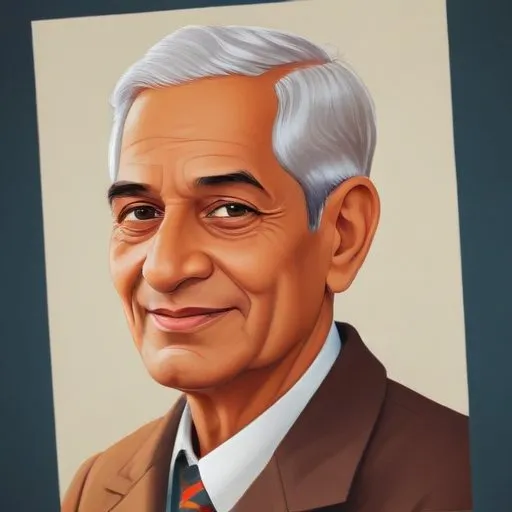
Pioneering Indian engineer who played a crucial role in the development of India's space program, particularly in the launch of the country's first satellite, Aryabhata.
Satish Dhawan, a renowned Indian mathematician and aerospace engineer, is widely regarded as the father of experimental fluid dynamics research in India. He led the successful development of the Indian space programme, earning him a revered place in the nation's scientific community.
Born on September 25, 1920, in Srinagar, Dhawan hailed from a Punjabi Khatri family. His father, Rai Bahadur Devi Dayal Dhawan, was a sessions and district judge. Dhawan's educational pursuits took him to prestigious institutions in India and the United States. He graduated from what is now known as Punjab Engineering College in Chandigarh, and later earned a Bachelor of Science in physics and mathematics from the Mughalpura Technical College in Lahore, Pakistan.
He furthered his education with a Master of Science degree in aerospace engineering from the University of Minnesota, Minneapolis, and an aeronautical engineering degree from the California Institute of Technology. Dhawan's Ph.D. in mathematics and aerospace engineering, completed under the supervision of Hans W. Liepmann in 1951, cemented his reputation as a trailblazer in his field.
In 1972, Dhawan assumed the role of chairman of the Indian Space Research Organisation (ISRO) and secretary to the Government of India at the Department of Space. This marked the beginning of a new era in India's space programme, with Dhawan at the helm. Under his leadership, ISRO achieved numerous milestones, including the successful development of the SLV-3, India's first experimental satellite launch vehicle.
Dhawan's guidance played a pivotal role in shaping the career of A.P.J. Abdul Kalam, who would later become the President of India. Kalam often credited Dhawan with instilling in him the confidence to pursue his dreams in space research.
The second launch pad of ISRO, the Satish Dhawan Space Centre, is named in his honour, a testament to his enduring legacy in the field of space research. Dhawan's contributions have inspired generations of scientists and engineers, earning him the distinction of being the man behind India's space programme.
His remarkable journey, marked by perseverance and dedication, serves as a beacon of inspiration for aspiring researchers and scientists. Satish Dhawan's legacy continues to propel India's space programme forward, cementing his place as one of the most esteemed figures in the nation's scientific history.
Satish Dhawan's remarkable life serves as a testament to the power of dedication and perseverance. His groundbreaking work in experimental fluid dynamics and space research has left an indelible mark on India's scientific landscape.
Born in 1919
Pioneering Indian physicist and academic who played a key role in the development of India's space program and founded the Indian Space Research Organisation (ISRO). He's also credited with establishing the Indian Institute of Management (IIM) in Ahmedabad.
94 Years Old
Indian engineer, academic, and politician who served as the 11th President of India, known for his contributions to the development of India's space program and missile technology. He's also a renowned author and inspirational figure.
Born in 1858
Pioneering scientist who made groundbreaking contributions to the fields of physics, biology, and botany, including the discovery of radio waves and the development of the crescograph, a device to measure plant growth.
Born in 1888
Indian physicist and academic who discovered the Raman effect, a phenomenon where light scattered by molecules changes wavelength, earning him the Nobel Prize in Physics in 1930.
Born in 1893
Developed the theory of thermal ionization, which explains the spectra of stars and led to the discovery of new elements, and was a pioneer in the field of astrophysics.
