


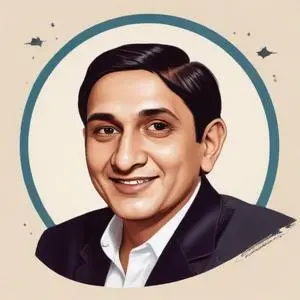
Pioneering Indian physicist and academic who played a key role in the development of India's space program and founded the Indian Space Research Organisation (ISRO). He's also credited with establishing the Indian Institute of Management (IIM) in Ahmedabad.
Vikram Sarabhai, the renowned Indian physicist and astronomer, is fondly regarded as the "Father of India's Space Program". He was the driving force behind India's entry into the elite club of space-faring nations, and his pioneering efforts paved the way for the country's nuclear power development.
Born on August 12, 1919, in Ahmedabad, Gujarat, Sarabhai belonged to the esteemed Sarabhai family, a clan of industrialists and nationalists who played a significant role in India's struggle for independence. He was the son of Ambalal Sarabhai, a prominent businessman and philanthropist.
Sarabhai's academic journey took him to Gujarat College in Ahmedabad, followed by the University of Cambridge, England, where he completed his Tripos in Natural Sciences in 1940. He later returned to Cambridge to pursue his Ph.D., submitting his thesis, "Cosmic Ray Investigations in Tropical Latitudes", in 1947.
In 1947, Sarabhai founded the Physical Research Laboratory (PRL), a humble beginning in his residence, "The Retreat", which would eventually become the cradle of space sciences in India. With the support of the Karmkshetra Educational Foundation and the Ahmedabad Education Society, PRL was formally established at the M.G. Science Institute, Ahmedabad, on November 11, 1947.
Under Sarabhai's visionary leadership, PRL's research focus expanded beyond cosmic rays and the upper atmosphere to encompass theoretical physics and radio physics, with grants from the Atomic Energy Commission. This marked the beginning of India's space program, which would go on to achieve numerous milestones in the years to come.
Sarabhai's contributions to science and the nation were recognized with several prestigious awards, including the Padma Bhushan in 1966 and the Padma Vibhushan, posthumously, in 1972.
Sarabhai married classical dancer Mrinalini in 1942, and the couple had two children, Mallika and Kartikeya. He practiced Jainism and was known for his simplicity and humility. Sarabhai's interests extended beyond science to sports and statistics, and he even set up the Operations Research Group (ORG), the first market research organization in India.
Vikram Sarabhai's legacy extends far beyond his contributions to India's space program. He inspired a generation of scientists and engineers, and his vision for a self-reliant India continues to shape the country's science and technology landscape. Today, India is a proud player in the global space community, and Sarabhai's pioneering efforts have paved the way for future generations to reach for the stars.
Vikram Sarabhai passed away on December 30, 1971, but his indelible mark on India's scientific landscape continues to inspire generations. His life's work serves as a testament to the power of vision, dedication, and perseverance, and his legacy will forever be etched in the annals of Indian history.
Born in 1889
India's first Prime Minister, a key figure in the country's struggle for independence from British rule, and a champion of democracy and secularism. He played a crucial role in shaping modern India's government and economy.
Born in 1917
The first female Prime Minister of India, serving from 1966 to 1977 and again from 1980 until her assassination in 1984, known for her strong leadership and economic reforms.
Born in 1884
India's first president, a key figure in the country's struggle for independence, who played a crucial role in shaping the nation's early years. He's revered for his leadership and commitment to democracy.
Born in 1909
Pioneering physicist who made groundbreaking contributions to the development of quantum mechanics and the discovery of subatomic particles, earning him the title "Father of Indian Nuclear Physics".
Born in 1920
Pioneering Indian engineer who played a crucial role in the development of India's space program, particularly in the launch of the country's first satellite, Aryabhata.
Born in 1921
Founded India's largest dairy cooperative, revolutionizing the country's milk production and empowering rural farmers. Known for transforming the dairy industry and creating a brand synonymous with quality and affordability.
Born in 1920
The first Dalit to hold the office, he served as the President of India from 1997 to 2002, known for his advocacy for social justice and human rights.
