


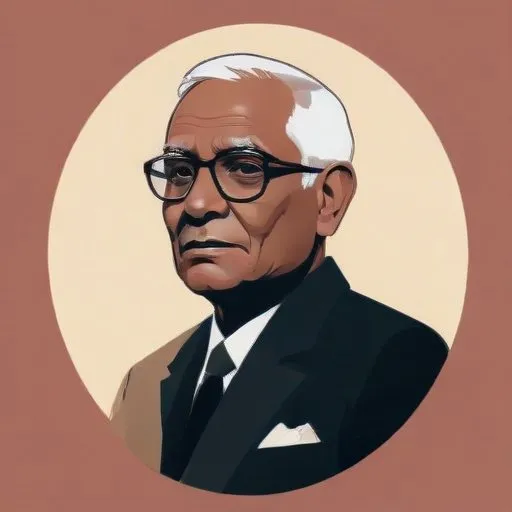
The first Dalit to hold the office, he served as the President of India from 1997 to 2002, known for his advocacy for social justice and human rights.
K. R. Narayanan, the tenth President of India, is revered for being the first Dalit to occupy the highest constitutional office in the country. His remarkable journey, marked by determination and perseverance, serves as a shining example of triumph over adversity.
Born on October 27, 1920, in Perumthanam, Uzhavoor village, in the princely state of Travancore (present-day Kottayam district, Kerala), Narayanan belonged to the marginalized Dalit community. His early life was marked by struggles, but he was driven by an insatiable thirst for knowledge and a desire to break free from the shackles of social oppression.
Narayanan's scholastic excellence earned him a scholarship to study at the London School of Economics. This exposure broadened his horizons, and he developed a deep understanding of global politics and international relations. Upon his return to India, he joined the Indian Foreign Service, where he served as a diplomat in various countries, including the United States and China. His diplomatic acumen earned him the reputation of being one of the best diplomats of the country, as acknowledged by Jawaharlal Nehru himself.
At the behest of Indira Gandhi, Narayanan entered the realm of politics, where he won three consecutive general elections to the Lok Sabha. He served as a Minister of State in Prime Minister Rajiv Gandhi's cabinet, further honing his skills as a statesman.
In 1992, Narayanan was elected as the Vice President of India, a position he held until 1997. His exemplary leadership and vision led to his election as the President of India, a position he held from 1997 to 2002. As the first Dalit to occupy the highest constitutional office, Narayanan's presidency was a beacon of hope for the marginalized sections of society.
Narayanan was often referred to as a "working president" who worked within the four corners of the Constitution. He believed in exercising his discretionary powers, often deviating from convention and precedent to ensure that the principles of democracy were upheld. His presidential tenure was marked by several landmark decisions, including the appointment of a Prime Minister in a hung Parliament, the dismissal of a state government, and the imposition of President's rule.
K. R. Narayanan's life and legacy serve as a testament to his unwavering commitment to the principles of equality, justice, and democracy. He played a pivotal role in shaping India's foreign policy, strengthening its international relations, and elevating the office of the President. As a champion of the marginalized, Narayanan's presidency will be remembered for generations to come as a symbol of hope and empowerment.
K. R. Narayanan's life is a testament to the power of determination, perseverance, and vision. As a beacon of hope for the marginalized, his legacy continues to inspire generations to strive for a more equitable and just society.
94 Years Old
The 13th Prime Minister of India, a renowned economist who led the country through a period of rapid economic growth and liberalization, implementing reforms that transformed India's economy. He is credited with helping to lift millions of people out of poverty.
79 Years Old
The first female President of the Indian National Congress, leading the party to a landslide victory in 2004, and playing a crucial role in shaping India's political landscape.
56 Years Old
Indian National Congress leader and scion of the Nehru-Gandhi family, known for his efforts to revitalize the party and promote social justice.
91 Years Old
The first female President of India, serving from 2007 to 2012, known for her efforts to empower women and the underprivileged. She played a significant role in shaping India's foreign policy and promoting education.
95 Years Old
Indian engineer, academic, and politician who served as the 11th President of India, known for his contributions to the development of India's space program and missile technology. He's also a renowned author and inspirational figure.
76 Years Old
The Chief Minister of Gujarat and 14th Prime Minister of India, a prominent figure in Indian politics, known for his economic reforms and nationalist agenda. He has been a dominant force in Indian politics for over two decades.
Born in 1904
The second Prime Minister of India, leading the country through a tumultuous period, including a war with Pakistan, and known for his simplicity, honesty, and dedication to the nation. He is also credited with promoting the Green Revolution, which transformed India's agricultural sector.
Born in 1917
The first female Prime Minister of India, serving from 1966 to 1977 and again from 1980 until her assassination in 1984, known for her strong leadership and economic reforms.
