


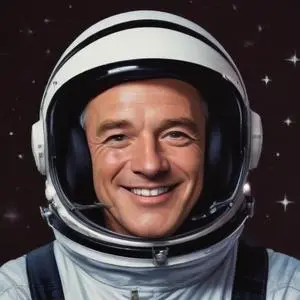
One of the original Mercury Seven astronauts, he orbited the Earth in 1962, paving the way for future space exploration. He was also a decorated naval aviator and aquanaut.
Scott Carpenter, a name synonymous with space exploration and underwater adventure, is renowned for being the second American to orbit the Earth and the fourth American in space. As one of the Mercury Seven astronauts, Carpenter's remarkable career spanned from flying combat missions in the Korean War to walking on the ocean floor as an aquanaut.
Born on May 1, 1925, in Boulder, Colorado, Carpenter developed an early fascination with flight. He earned a Bachelor of Science degree in aeronautical engineering from the University of Colorado in 1949 and was commissioned into the U.S. Navy. Carpenter flew combat missions in the Korean War and later attended the U.S. Naval Test Pilot School, where he became a test pilot.
In 1959, Carpenter was selected as one of the Mercury Seven astronauts, alongside Alan Shepard, Gus Grissom, John Glenn, Wally Schirra, Gordon Cooper, and Deke Slayton. As backup to Glenn during the Mercury Atlas 6 orbital mission, Carpenter flew the next mission, Mercury Atlas 7, on May 24, 1962, in the spacecraft he named Aurora 7.
Despite a series of malfunctions, Carpenter's spacecraft landed 250 miles downrange from its intended splashdown point. Both pilot and spacecraft were retrieved, marking a significant milestone in the American space program.
After his brief stint as an astronaut, Carpenter obtained permission from NASA to take a leave of absence to join the U.S. Navy SEALAB project as an aquanaut. In 1965, he spent 28 days living on the ocean floor off the coast of California as part of SEALAB II.
Carpenter's experience in space and underwater exploration led to his appointment as Director of Aquanaut Operations for SEALAB III in 1967. He retired from NASA in 1967 and from the Navy in 1969, leaving behind a legacy of pioneering achievements in both space and sea.
Scott Carpenter's remarkable career exemplifies the spirit of exploration and innovation. As an astronaut, he expanded humanity's understanding of space, and as an aquanaut, he pushed the boundaries of underwater exploration.
Carpenter's contributions have inspired generations of scientists, engineers, and explorers. His legacy serves as a testament to the power of human ingenuity and the importance of continued exploration and discovery.
"The world itself is a mystery, and we're all just trying to figure it out."
Scott Carpenter's words continue to inspire and motivate people to explore, discover, and push beyond the boundaries of human knowledge.
98 Years Old
American baseball player who pitched in the Major Leagues from 1965 to 1975, known for being a four-time All-Star and winning the American League ERA title in 1968.
Born in 1923
First American in space, commanded Apollo 14 mission, and walked on the Moon.
Born in 1926
One of the original seven astronauts in NASA's Project Mercury, a decorated military pilot, and a pioneer in space exploration, known for being the second American in space and commanding the first manned Gemini mission.
Born in 1923
One of the original seven astronauts in Project Mercury, this pioneer flew on three historic spaceflights, including the first American manned orbital flight and the Apollo 7 mission.
99 Years Old
One of the original seven astronauts in Project Mercury, he was the first American to spend over a day in space and the last to fly solo in orbit, paving the way for future space exploration.
96 Years Old
Led the third manned mission to land on the Moon, Apollo 12, and became the third person to walk on its surface. Known for his bold and fearless approach to space exploration.
96 Years Old
First person to walk on the Moon during the Apollo 11 mission, marking a historic milestone in space exploration.
96 Years Old
Second man to walk on the Moon during the Apollo 11 mission, a pioneering astronaut and advocate for space exploration.
